
The Harrisons below the Pound
As we approach the ‘bottom part’ of Derby Road towards West Hallam, Adeline rather vaguely describes this next part of the journey.
“Lower down Derby Road, below the Pound, was an old cottage in a garden. A Harrison lived in it. There were many Harrisons in Ilkeston at that time. I do not know whether they were distantly related or not.”
The Pound was possibly the pinfold, on the north side of Derby Road, just past Kester Harrison’s house.
The old cottage was on the same side, mid-way between the pinfold and the Derby Road windmill.
Adeline listed many Ilkeston’s Harrison inhabitants, several of them very elusive.
The Harrisons of Derby Road may have been couple Thomas and Susannah (nee Clifford), daughter of framework knitter Robert and Elizabeth (nee Wilkinson).
Thomas was also a framework knitter when he married Susannah in September 1826 but in later life converted to coal higgler.
In 1824 Susannah had given birth to illegitimate son Thomas who adopted the name of Harrison after his mother’s marriage and lived with them in Moors Bridge Lane until his own marriage to Mary Raynor in 1848.
Thomas senior died in the Lane in October 1861 and his wife six years later. Both were aged 82.
The Straws of old Moor Brig
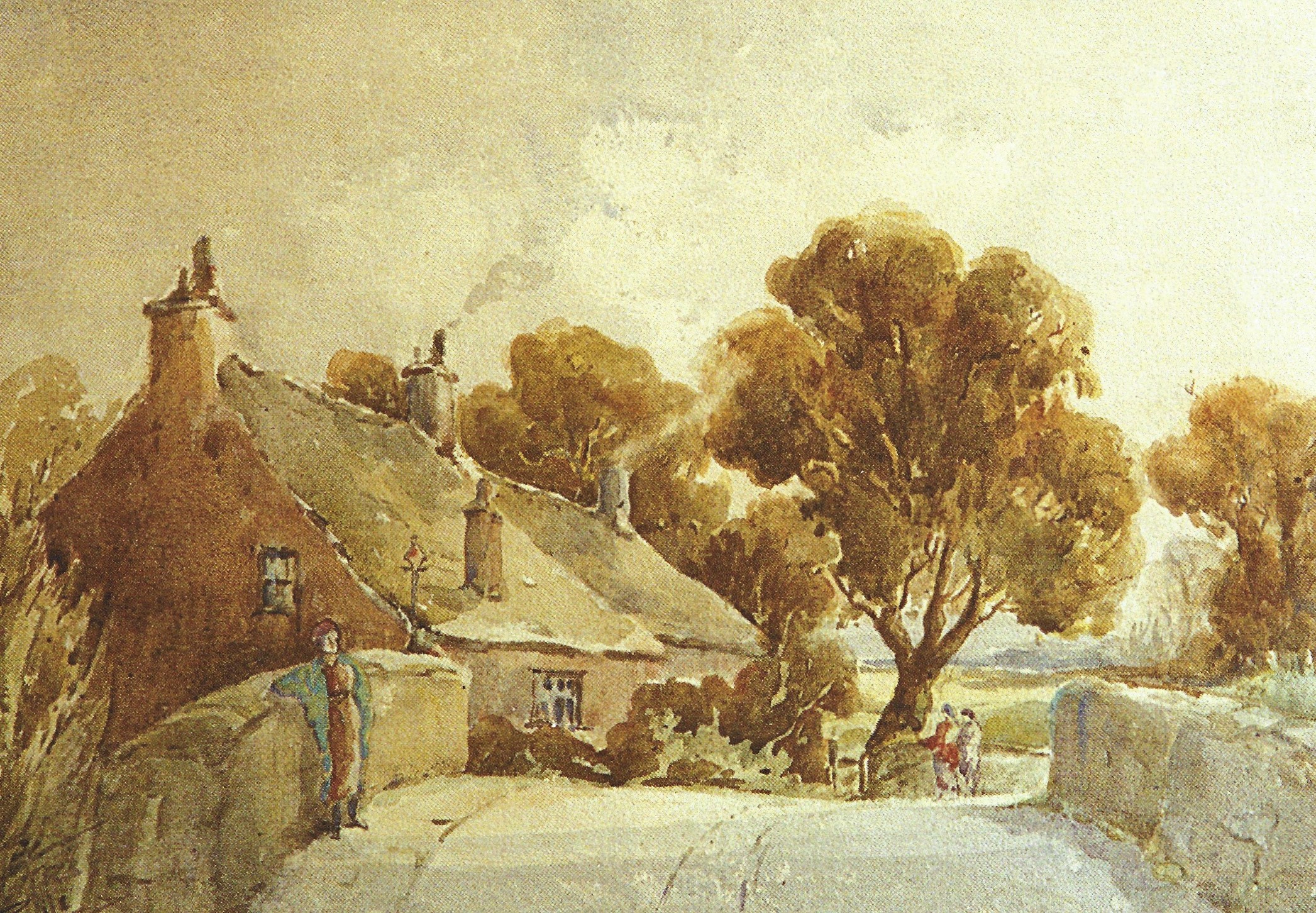
Straw’s Bridge by Fred Riley
Adeline continues “We now see the old mill but not any house until we come to the old Nutbrook canal bridge.” The “old mill” is the windmill off the north side of Derby Road. In this map (below) we are walking along Derby Road, (from right to left) past the Windmill which had been moved from the site of Field House.
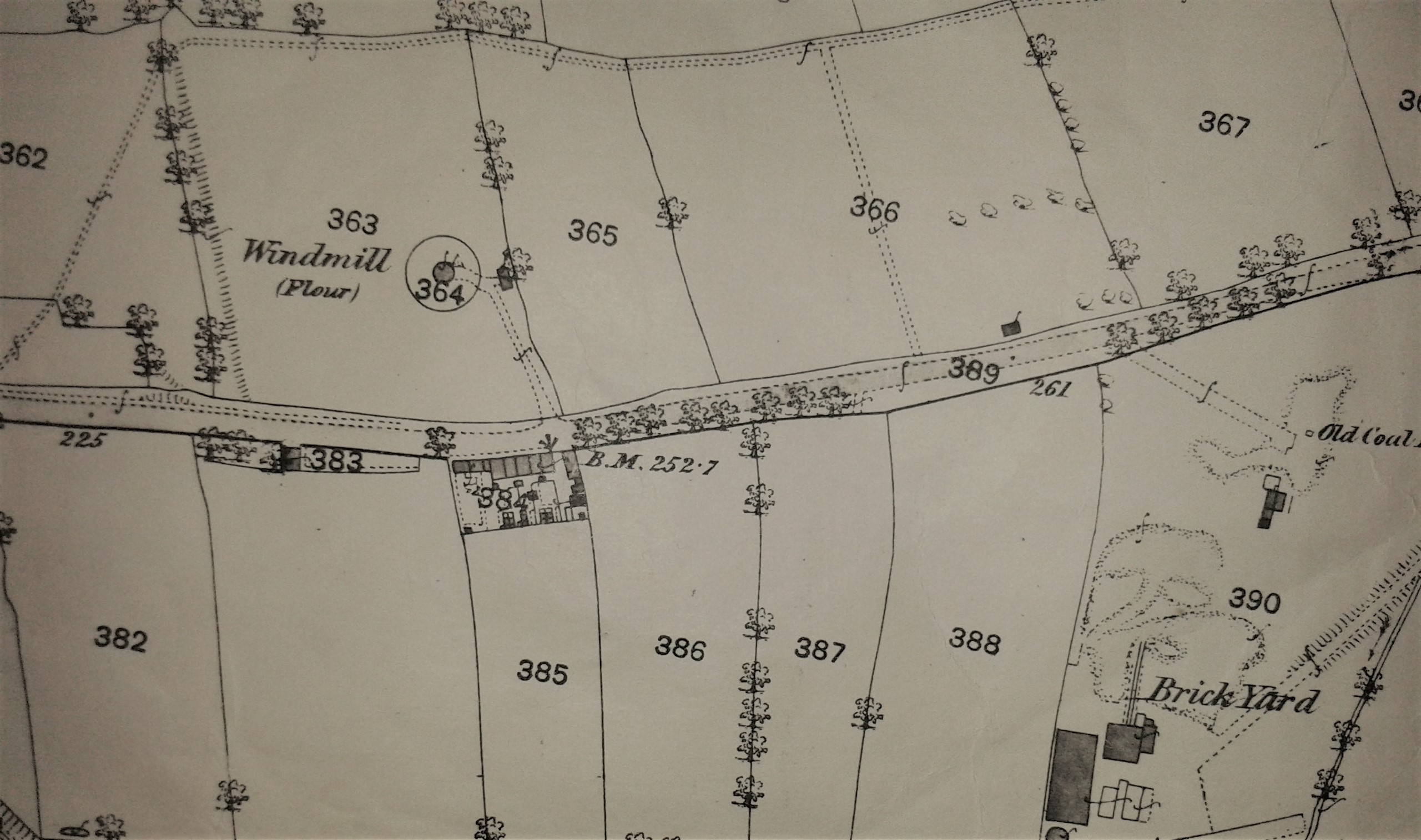
And as we walk on a little further into sight comes Straw’s Bridge, the lock, workshops and cottages there. (below)
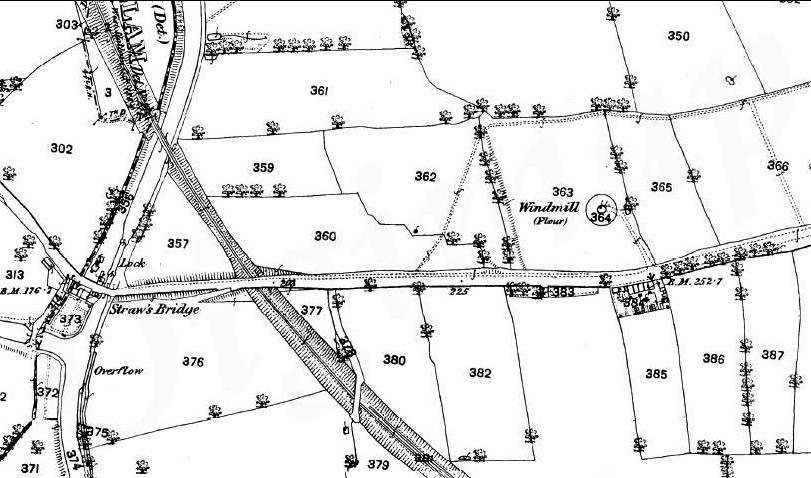
Above, the 1880 map continues, to show Straw’s Bridge
In its early life the Nutbrook Canal at Moor’s Bridge had several lock-keepers. One of these was Henry Cordon of Trowell who got the job in April 1824 — hence the name of “Cordon’s Lane” given to Moors Bridge Lane alias Derby Road. A lock-keeper’s cottage at Moor’s Bridge had been built in 1803/4 and this was now occupied by the Cordon family.
At the end of 1828 another employee of the Nutbrook Canal Company, Samuel Straw, had moved into a new canal house near Stanton Lane, and in April 1844 the same (?) Samuel Straw moved to occupy Cordon’s house at Moor’s Bridge. Henry Cordon’s wife Elizabeth (nee Bailey) had died in 1846 and Henry had then moved to trade as a publican in Pinfold Lane, Stapleford. For Samuel Straw the house was rent-free and it was at this time that the name of the bridge was changed to Straw’s Bridge.
The Straw family
Adeline briefly introduces us to the Straw family: “In this home lived the Straws. The two daughters had a Girls’ School, nearly at the bottom of Bath Street.” Let’s have a look at them in a little more detail.
Born in Newthorpe, Nottinghamshire in 1789 Sarah Rowland, the daughter of William and Amy (nee Levers), married Samuel Straw junior at Greasley Parish Church on June 18th, 1813. Sarah had just given birth to an illegitimate son whose father was, most probably Samuel junior. He had been born at Ilkeston in 1796, the son of sawyer Samuel senior and Ann (nee Winfield).
The baptisms of their children and the census suggest that initially Samuel junior and Sarah lived at Newthorpe Common until about 1828 before moving to Stanton Lock where Samuel was described as a lock-wright. Then in 1844 the family moved into the house at Moors Bridge Lane where Samuel was a ‘canal agent’.
That is where the couple spent the rest of their lives. Sarah died there on July 2nd, 1861 and Samuel junior on November 8th, 1872.
—————————————————————————————————————————————————-
The children of Samuel and Sarah Straw
Sarah’s illegitimate child was Aaron Rowland, born at Loscoe on March 3rd, 1813. (At his second marriage in 1867 he gave his name as ‘Aaron Rowland Straw‘ and his father as ‘agent, Samuel Straw‘).
Aaron spent the first part of his life as a “Rowland” before converting to a “Straw” or “Rowland Straw”, though for nearly all of his life he worked as ‘an engineer’.
He married Alice Jarvis of Stanton by Dale on August 3rd, 1835 and the couple had four children — Hannah (1836), Samuel 1839), Sarah (1842) and Mary Ann (1845) — all baptised as ‘Rowland’, and while the family was living in the Stapleford/Sandiacre area.
The family then moved to Derby where Alice died in 1853 (as a ‘Straw’). Aaron lived some time as a widower, moving to Basford and then Nottingham, where he married Mansfield-born widow Lavinia Goodall (nee Simpson) on August 18th, 1867. Her previous husband was twist-hand John Goodall, whom she had married on May 4th, 1847 at Mansfield, just after the birth of her illegitimate son, Robert Simpson, a year earlier. Robert later adopted the name of ‘Goodall’.
The Straw couple continued to live in Nottingham where Aaron died in 1895 and Lavinia in 1901.
Alfred Straw was born on September 4th, 1819 at Newthorpe Common. He seems to have started his working life assisting his father first at the Stanton Lock and then at Moor’s Bridge Lane lock, as a sawyer/woodworker. He married Matilda Brown, daughter of Kirk Hallam farmer John and Mary (nee Frost?) on November 29th, 1860. For all his married life Alfred traded as a grocer, at Bramcote and then at Long Eaton.
Alfred died at his family home of 4 Gladstone Street, Long Eaton, on February 2nd, 1897, and Matilda at the same address on December 21st, 1906.
William Rowland Straw was born on November 19th, 1820 at Newthorpe Common, and for all his working life was a sawyer/carpenter. On June 26th, 1848 he married Elizabeth Mellor, daughter of Anchor Row residents William and Rhoda (nee Palmer), and sister of John and William Mellor.
Like his elder brother, William and his family eventually settled in Long Eaton, just a couple of doors apart.
Harriett Straw was born at Newthorpe Common on May 30th, 1823 and then …… possibly died there, aged 2 years.
George Straw was born on March 16th, 1825 at Newthorpe Common. On May 17th, 1847 he married Elizabeth Eley/Eyley of Cossall, daughter of coal agent Benjamin and Mary (nee Husbands). They departed for Nottingham in the late 1850s with their four Ilkeston-born children, later to add another one.
Sarah Ann Straw was born at Newthorpe Common on November 18th, 1826 and died, an unmarried dressmaker, at Moor’s Bridge Lane on August 8th, 1856.
Caroline Straw was born at Stanton Lock on July 21st, 1828. She lived with her parents and worked alongside her father. In 1878, aged almost 50, she married collier Benjamin Samuel Brown. She died in April 1882 at the home of her brother Charles at Trent Lock.
Samuel Straw was born on July 8th, 1831 at Stanton Lock. He lived with his parents as a book-keeper/canal agent and died of typhus, at the registered age of 26, on March 19th, 1857.
Charles Straw was born at Stanton Lock on March 24th, 1832. He also was employed as a book-keeper/canal agent, initially on the Nutbrook Canal but later, on the Erewash Canal. He married Jane Rowley on July 24th, 1863. Though born in Eastwood, Jane had come to Ilkeston with her family in the late 1840s where her father William traded as a gardener and greengrocer in South Street.
Charles and Jane had one daughter, Miriam Minnie, but she died on April 3rd, 1865, aged 10 months.
I believe that Charles died at 8 Brookhill Street, Stapleford on Christmas Day, 1905.
Julia Straw was born at Stone Wharf Lock, Stanton on December 20th, 1833. Living with her parents she married canal boatman Isaac Newton on February 13th, 1862. With their son Theodore, born in 1863, the couple moved around the Midlands and at the end of the century, Isaac and son were working as colliery banksmen at Coleorton, Thringston, Leicestershire. While living there Julia was admitted to Leicester Asylum where she died in 1908.
—————————————————————————————————————————————————-
Mystery alert!
As Adeline writes “the two daughters had a Girls’ School, nearly at the bottom of Bath Street”
There were in fact four daughters of the marriage though only three came to live in Ilkeston.
Sarah Ann died unmarried in 1856, aged 29, described as a dressmaker.
Caroline lived in the Lane with her parents until she married collier Benjamin Samuel Brown in March 1878.
Like Caroline, Julia was a ‘housemaid’ and lived at home until 1862 when she married Isaac Newton.
I have as yet not found evidence linking any of them to the ‘bottom of Bath Street’ school.
But we have walked far enough. We now turn and walk back to the White Lion Square area, on the other side of Derby Road and visit the Hollis household.
