
The firm of Messrs. J.N. Beardsley, builders of Northgate Street, was established in 1903 and since that time it has carried out many new builds, alterations and additions to the social and industrial fabric of the town … and to the surrounding area. Many of the firm’s documents survive, and a selection of these has been used to illustrate the work which the Beardsley family carried out. By their nature they are all outside the ‘scope’ of the Victorian era but I thought they might be of interest to local historians.
______________________________________________________________________
Archer Street (1927)
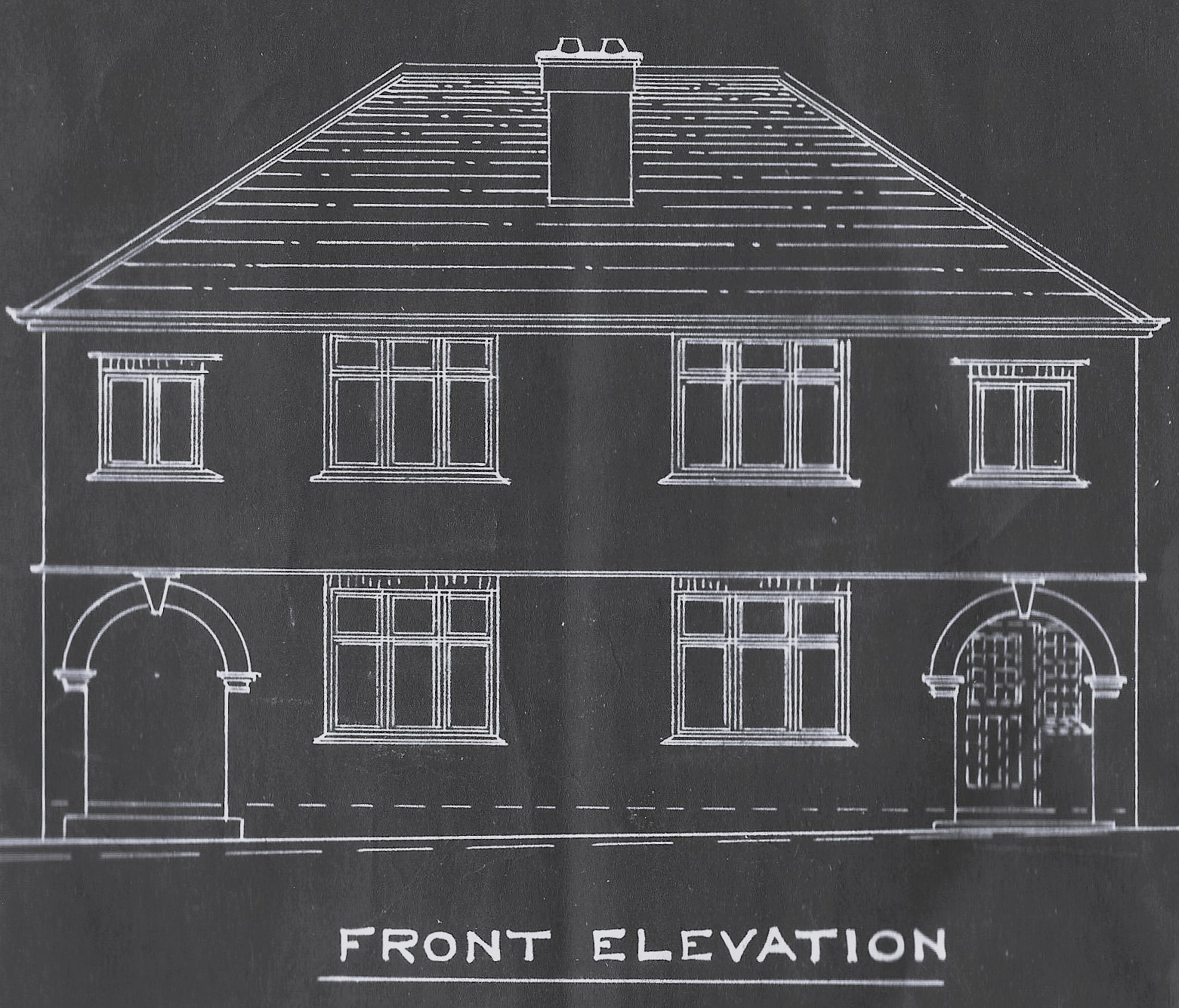
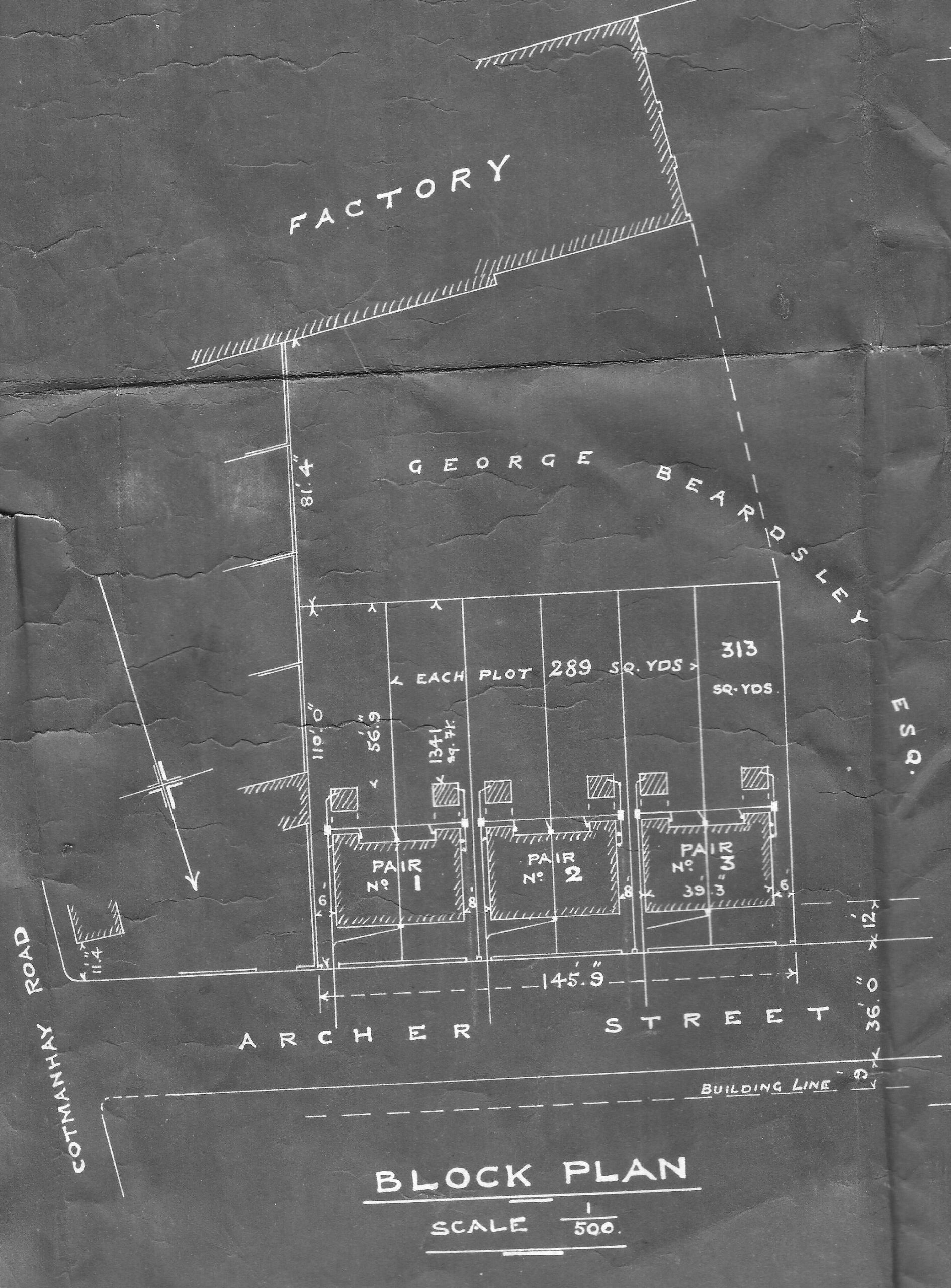
These plans, drawn up by architect and surveyor George J. Lee of East Street in 1927, show part of the building specifications for three pairs of houses at the Cotmanhay Road end of Archer Street. They were commissioned by George Beardsley who owned the land upon which they were built and they are still there today, being numbers 62 to 67.
______________________________________________________________________
Awsworth Road and the Commercial Inn (1933)
In 1933 the Home Brewery Company decided that one of its tied house – the Commercial Inn on Awsworth Road, Ilkeston – needed a “spruce up”.
Specifically, it required improved “sanitary conveniences and outbuildings “ as well as several internal and external repairs which included new large entrance gates to the yard.
Before alterations
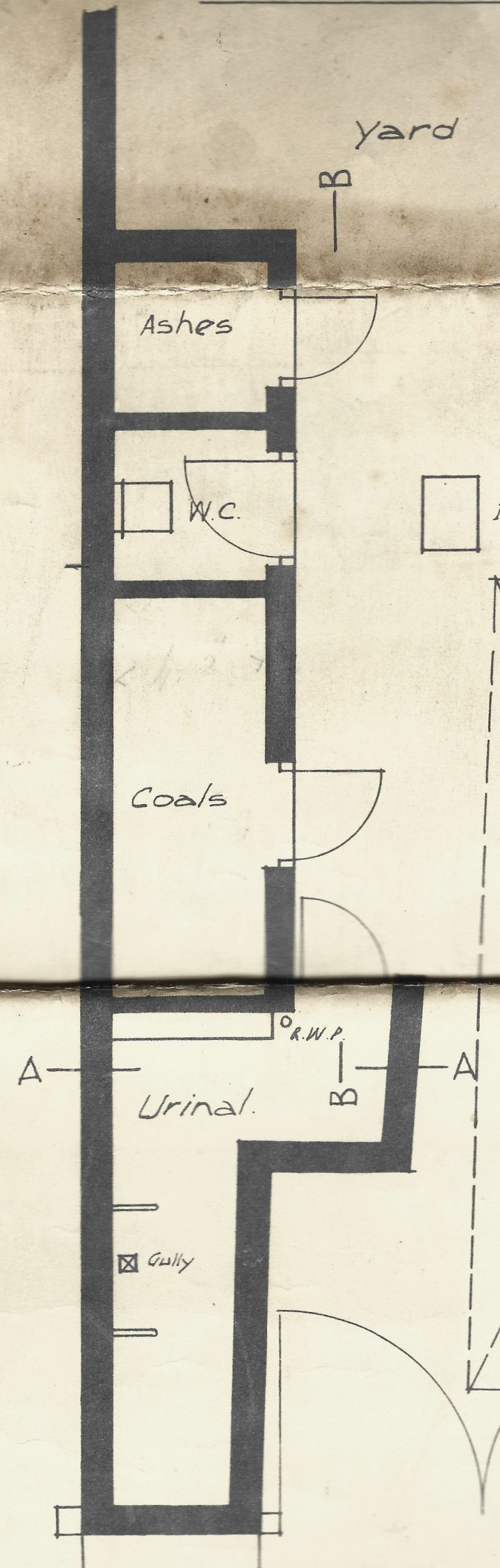
The firm’s architect drew up plans for the alterations with very strict and precise instructions for contractors to follow and then asked for tenders.
The chosen tender was from local builders “J.N.Beardsley & Sons” of Northgate Street who would do all the work for just under £120.
Awsworth Road is at the bottom of the plans which were drawn up by surveyor H. R. Robinson of the Home Brewery Co. Ltd.
After alterations
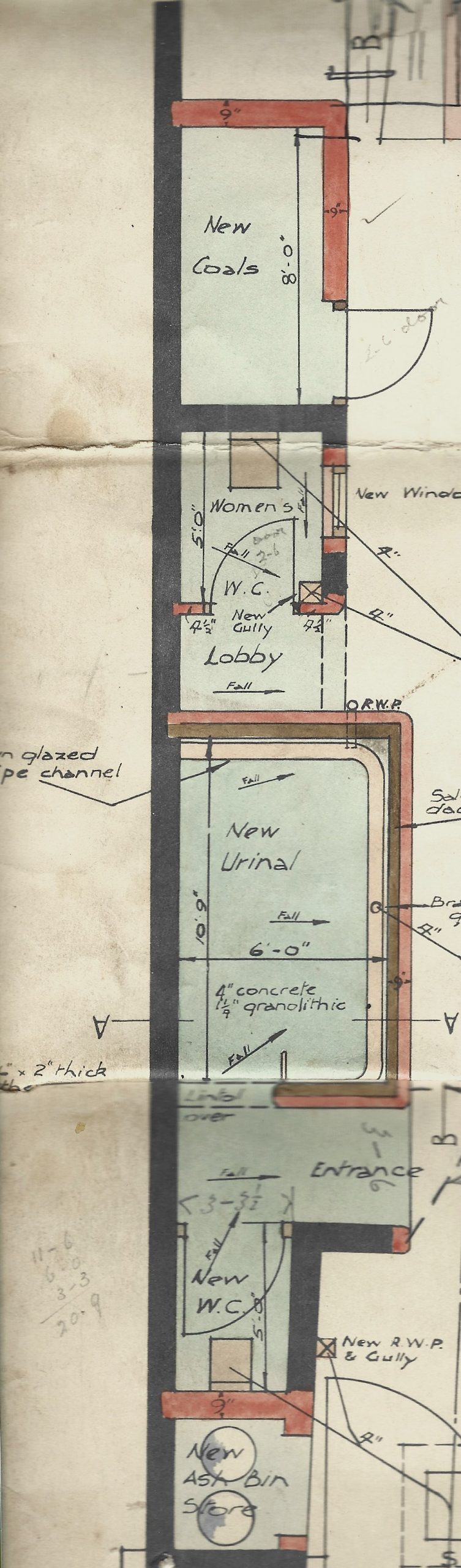
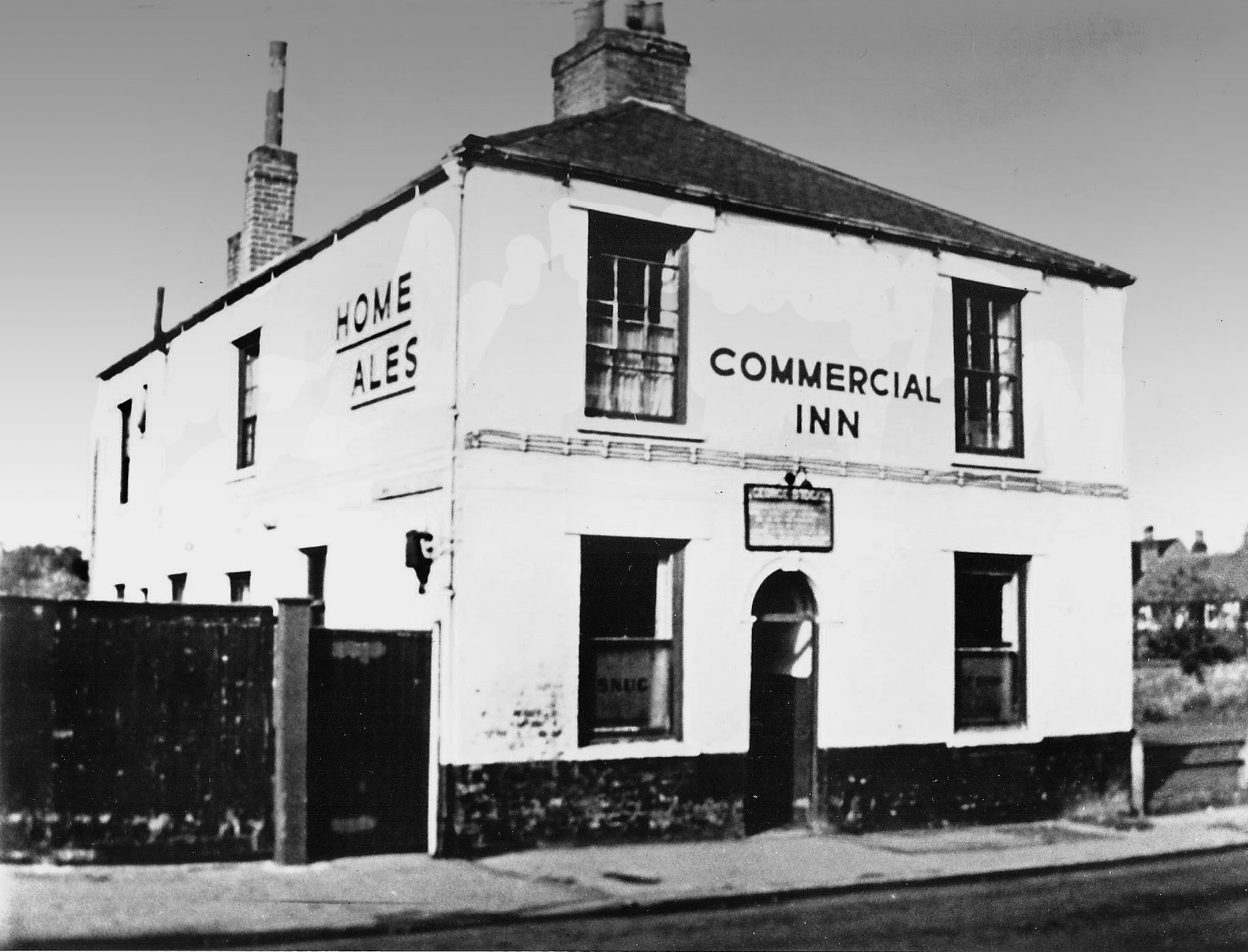
the Commercial Inn in the 1950s
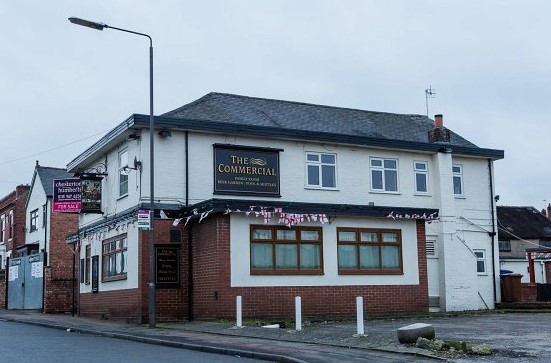
the Commercial Inn a short time before demolition in 2015
______________________________________________________________________
Cotmanhay Road (1928)
The plans below were drawn up by Ernest Goddard, formerly of 23 Wood Street, Ilkeston, who was living at 31 Langtry Grove in Nottingham in 1928, with his wife Keturah (nee Brooker).
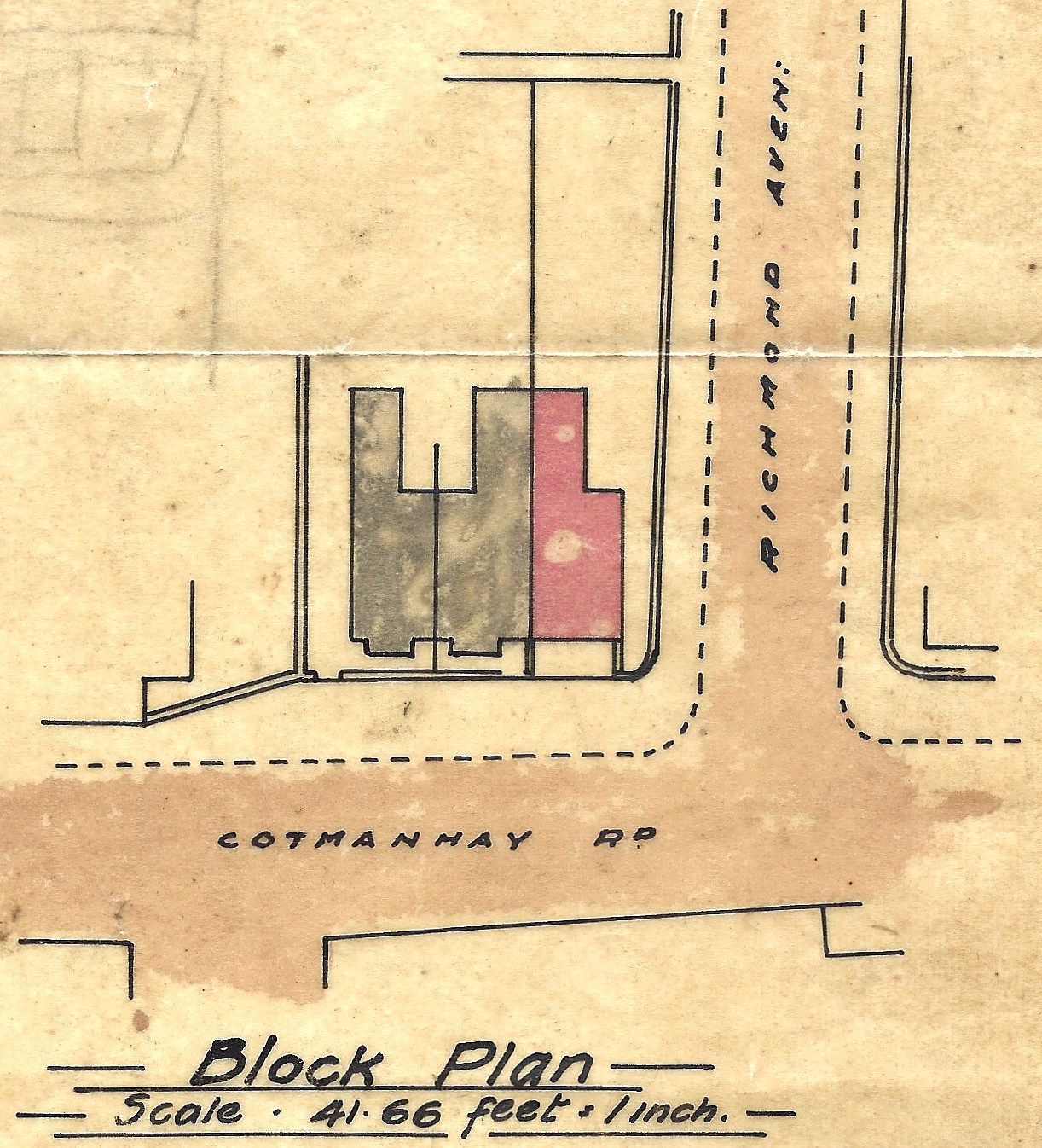
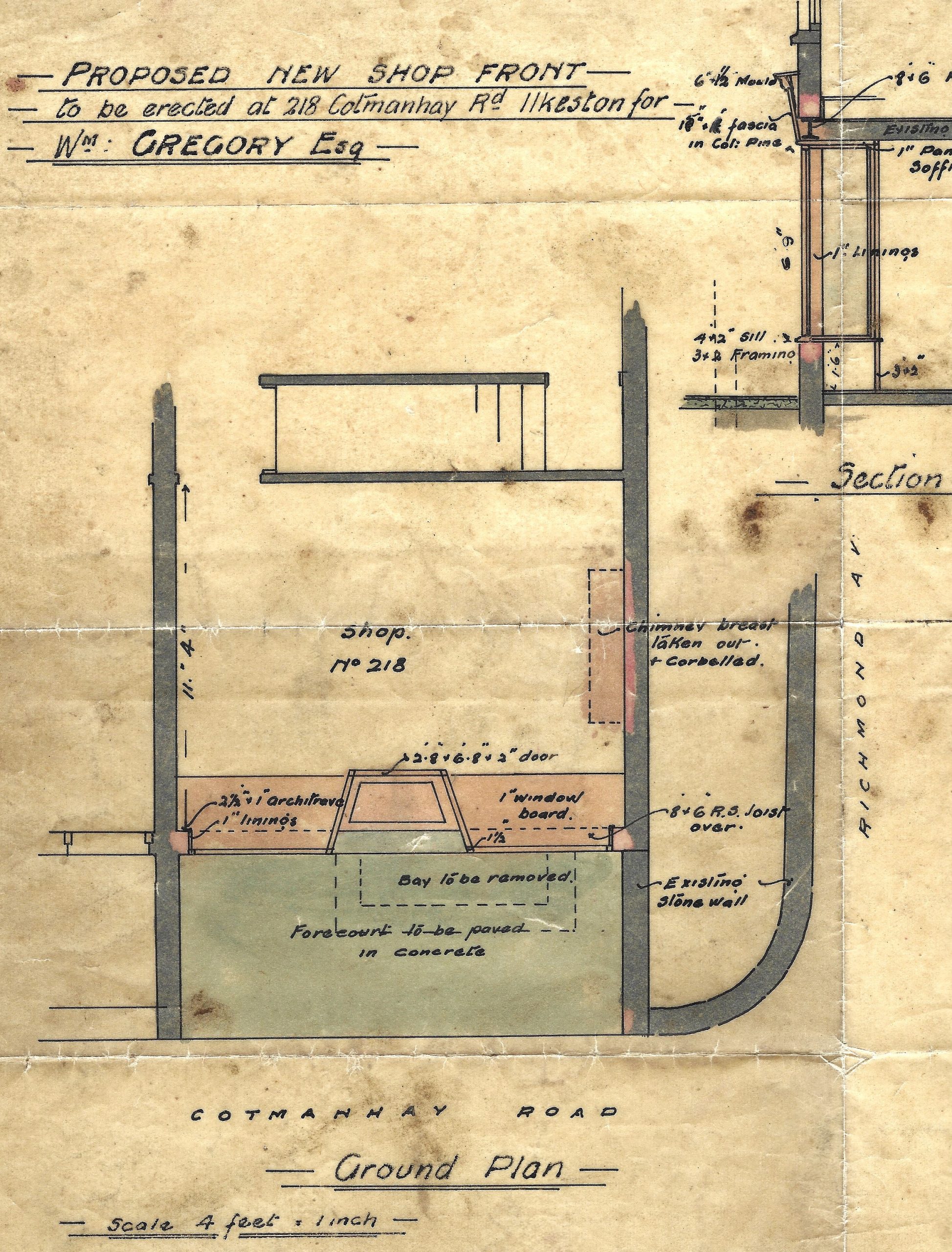
A new shop front at 218 Cotmanhay Road
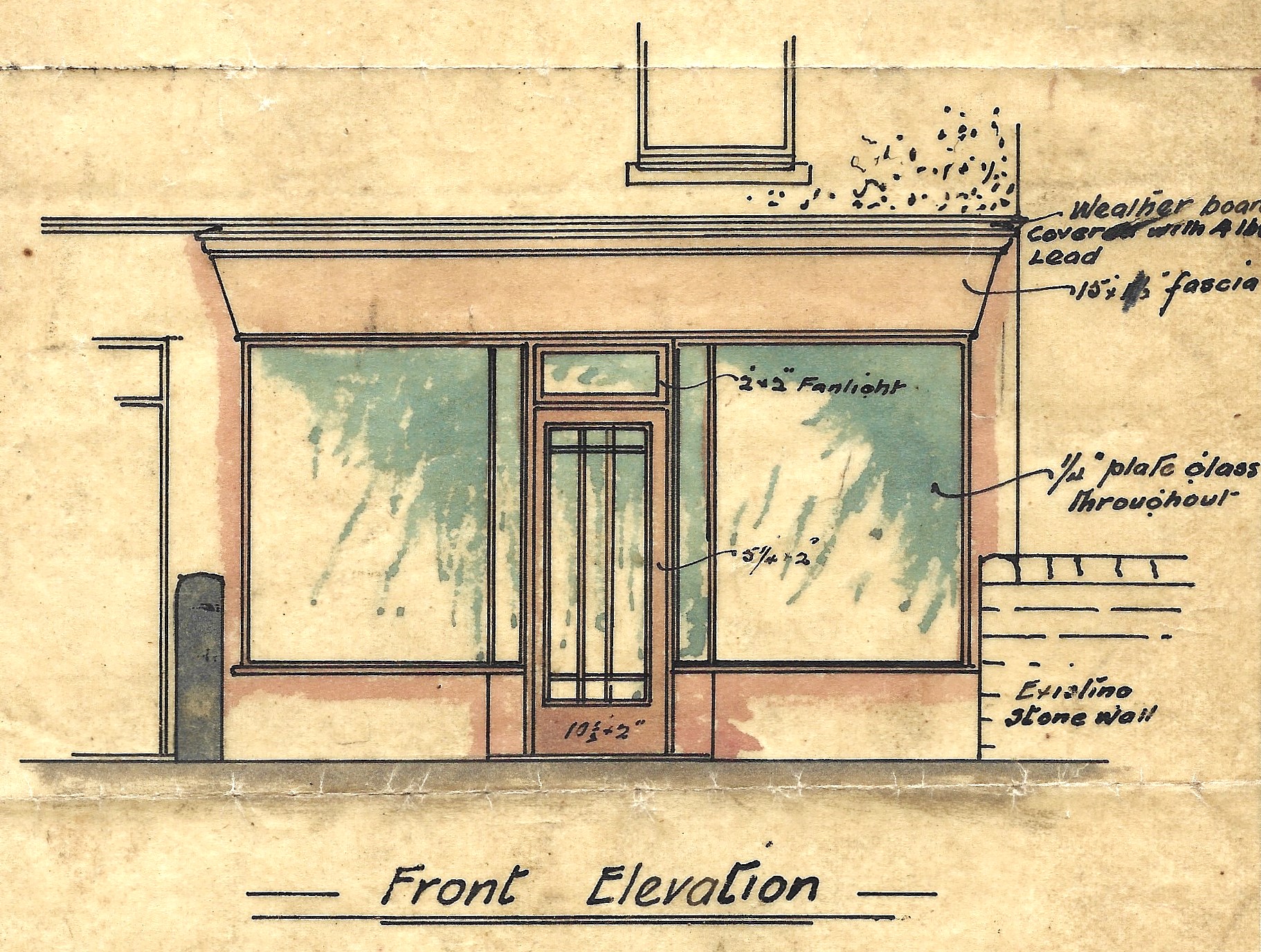
The sketch map (left) shows that the property was at the junction of Richmond Avenue with Cotmanhay Road. The job was to remove a large bay window and replace it with plate glass shop windows while the existing stone wall, at the right, would remain; I believe it is still there today. The occupier at the time was William Gregory
______________________________________________________________________
Grove Terrace (1933)
Grove Terrace was a group of ten isolated houses, located down the Ropewalk, off the south side of Station Road. They were built on the east bank of the Erewash Canal, while to the west lay the River Erewash and the boundary line of Nottinghamshire. In 1933 the property was owned by John Moss Towson, a farmer and landowner who lived at the Old Rectory in Towell.
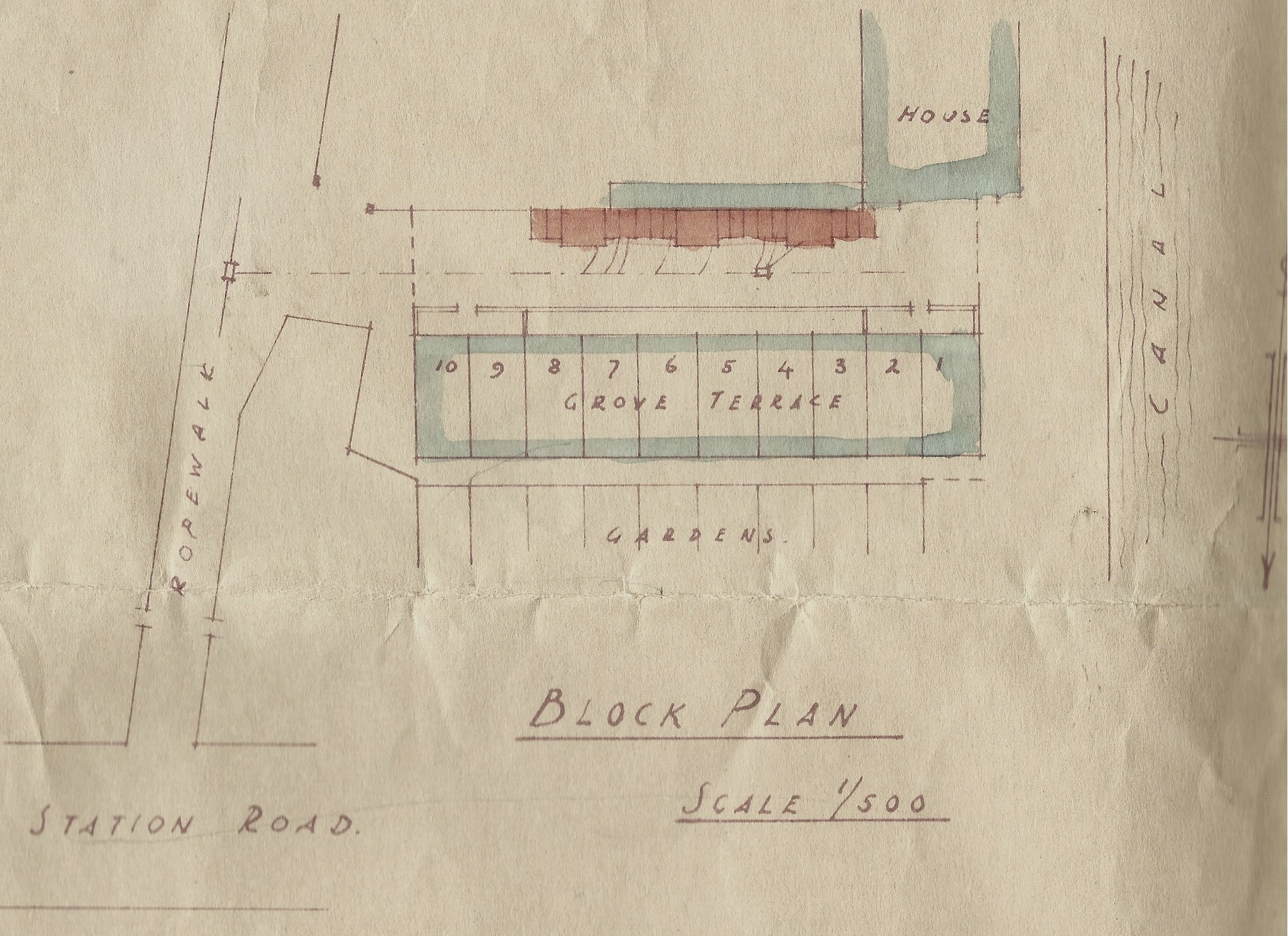
As the sketch map, above, shows (with north to the bottom) number 1 was closest to the canal while number 10 was adjacent to the Ropewalk.
In 1933 it was decided that the houses were in need of new outbuildings (shaded red on the map) and J.N. Beardsley & Sons were employed as contractors after their estimate of £299 15s was accepted.
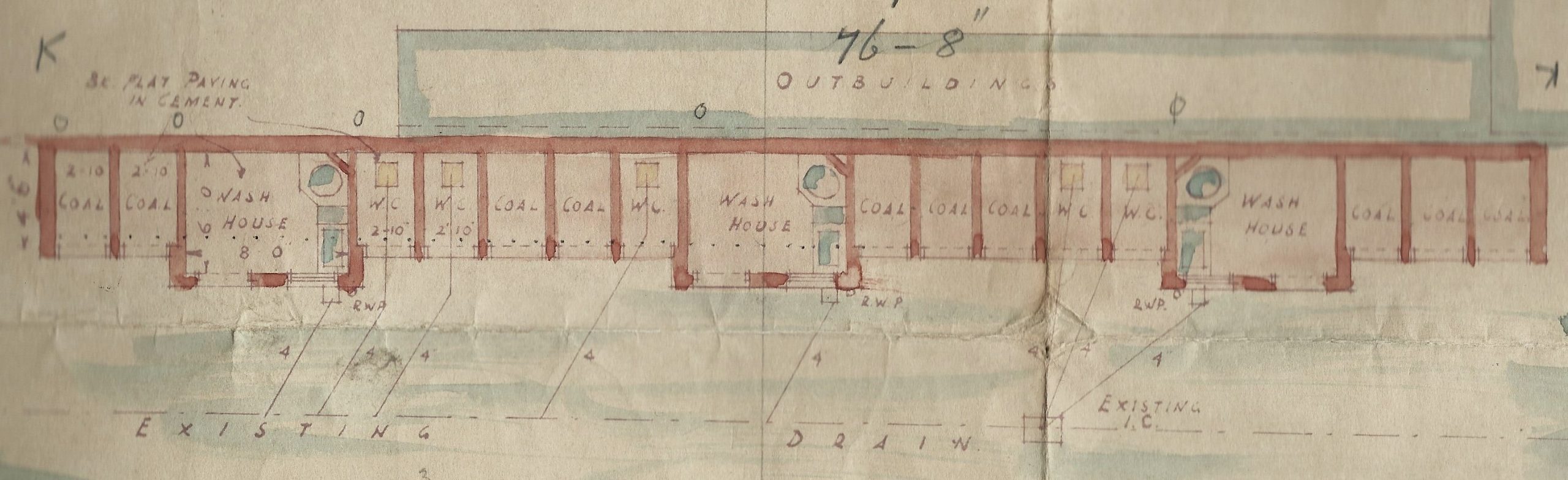
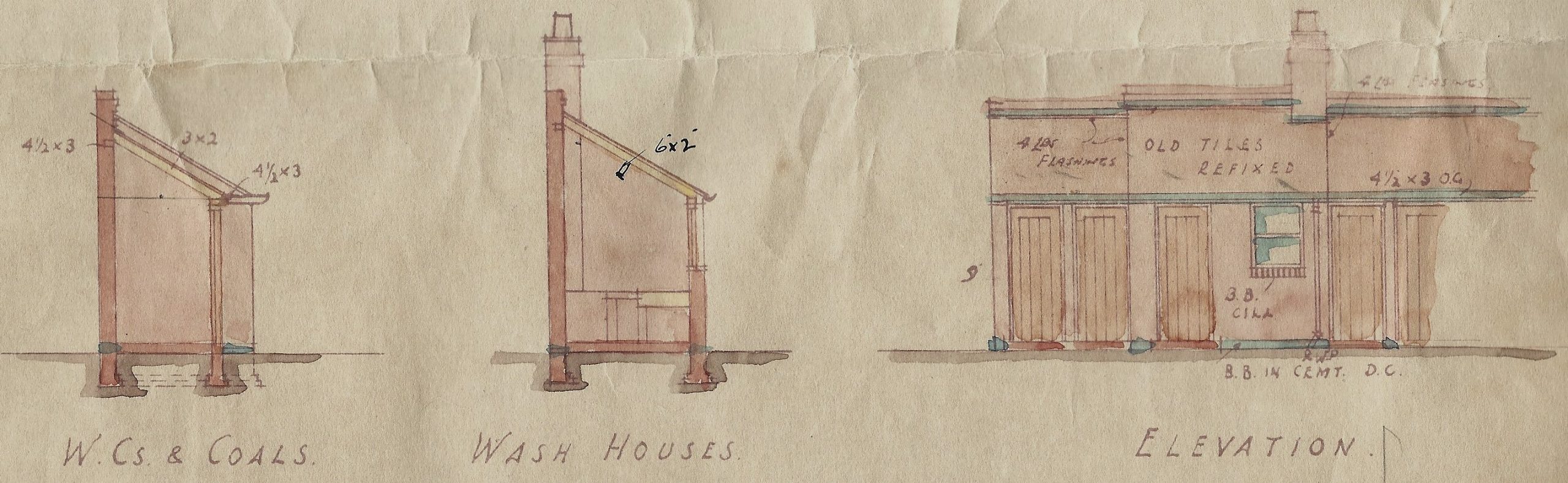
The diagram on the left shows 10 coal houses, 5 W.Cs, and 3 wash houses … I leave you to work out how they mght be allocated among the residents.
Within a couple of months the work was complete and the architect and surveyors, Bright and Thoms of Nottingham, who supervised the work, wrote to the Beardsleys … “we should like to express our appreciation of the splendid manner in which the works have been carried out” (October 10th, 1933)
______________________________________________________________________
Heanor Road and Rutland Farm (1935)
In 1935 the farm was sited on the west side of Heanor Road and a very short distance to the south-west of the former Ilkeston Hospital which in turn was opposite Charlotte Street. All clear ?
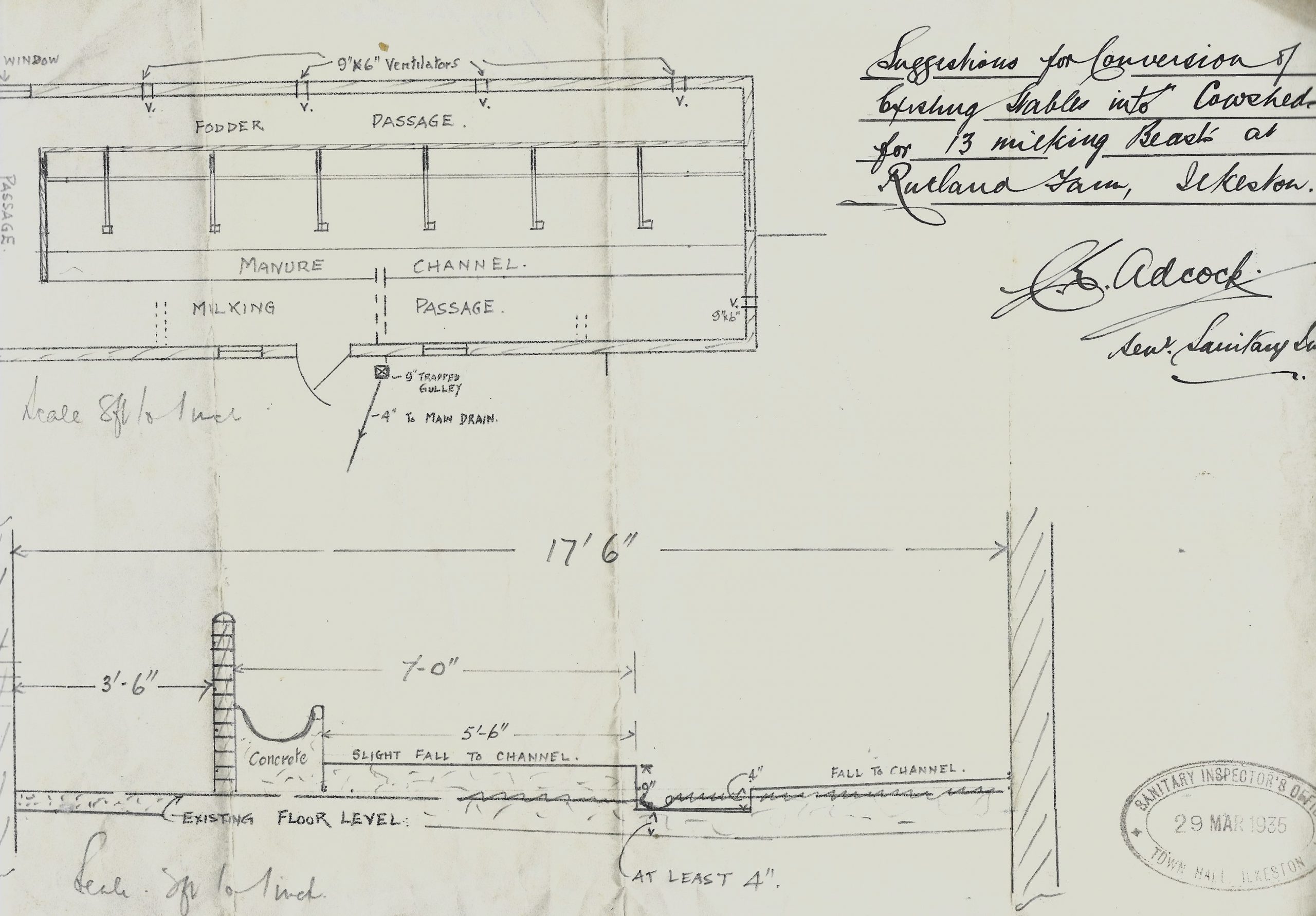
This suggestion came from the Council’s Sanitary Inspector’s Office. He was Cyril Ellis Adcock and held office from 1934 to 1968.
______________________________________________________________________
Ilkeston Junction (1949)
In 1885 the Nottingham based knitwear firm, first established in Tewkesbury in 1815 by the founder James Blount Lewis, set up a branch factory at Ilkeston Junction and in 1893 the firm became J B Lewis Limited. In 1951 it became a public company and the name was changed to Meridian Ltd.
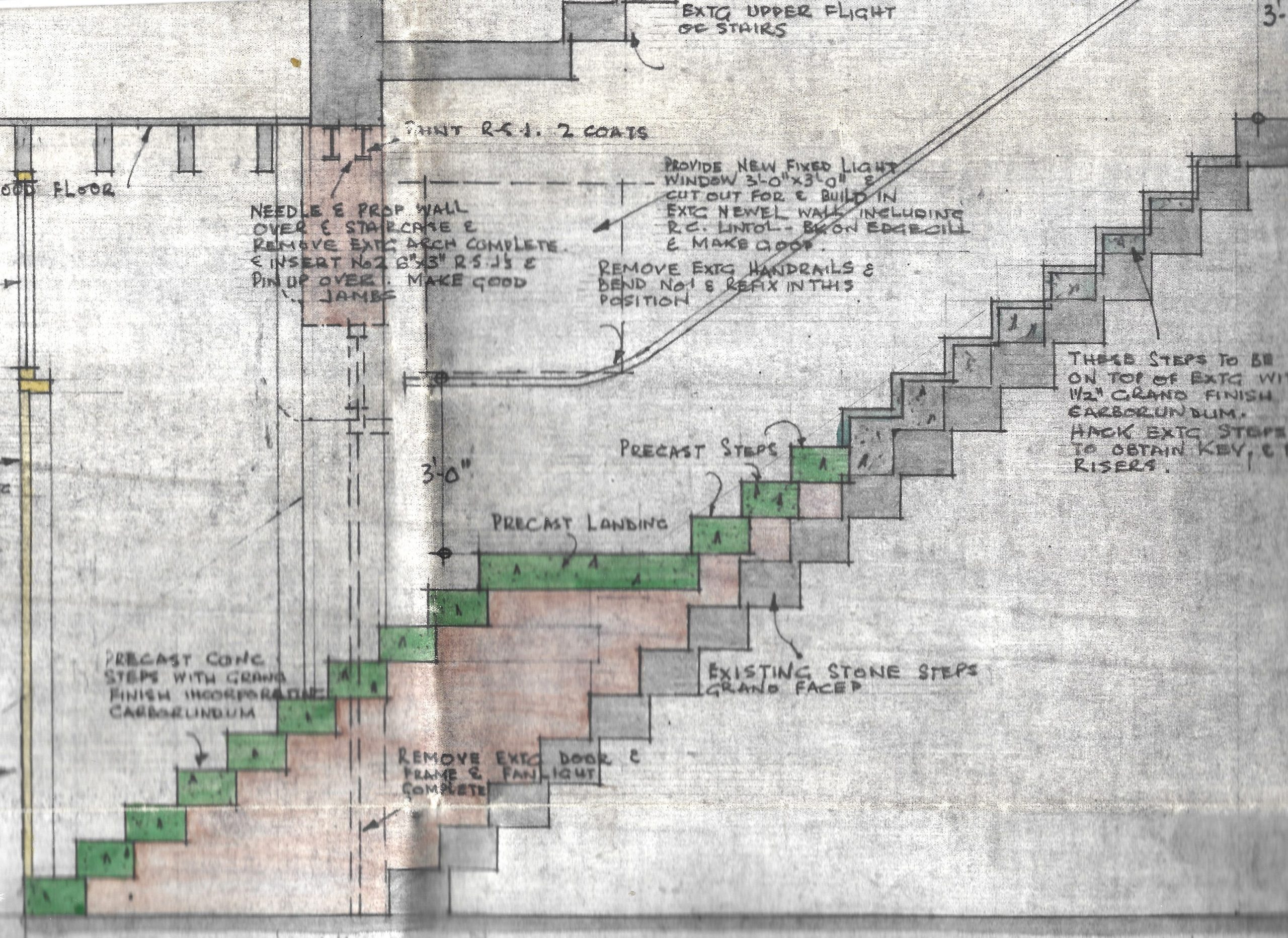
Just before this change, in 1949, J.N. Beardsley & Sons were contracted to alter a main staircase within the factory. The old steps were to be covered by new precast steps, each one 10 inches wide with seven inch risers. Alterations to the hand rails and lighting were also stipulated. Other than several views and elevationsof the stairs little paperwork remains
______________________________________________________________________
Market Street (1926)
Dr Sydney Walker Lund lived and worked at 14 Market Street throughout the 1920s and up to his death on April 13th, 1954. His house with the two bay windows appears on the photo below. It is still there today.
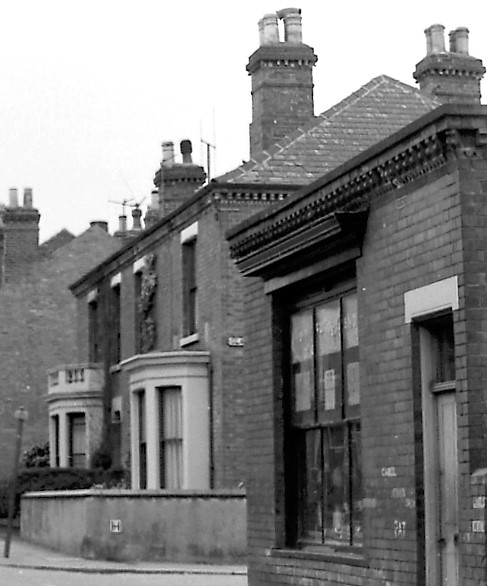
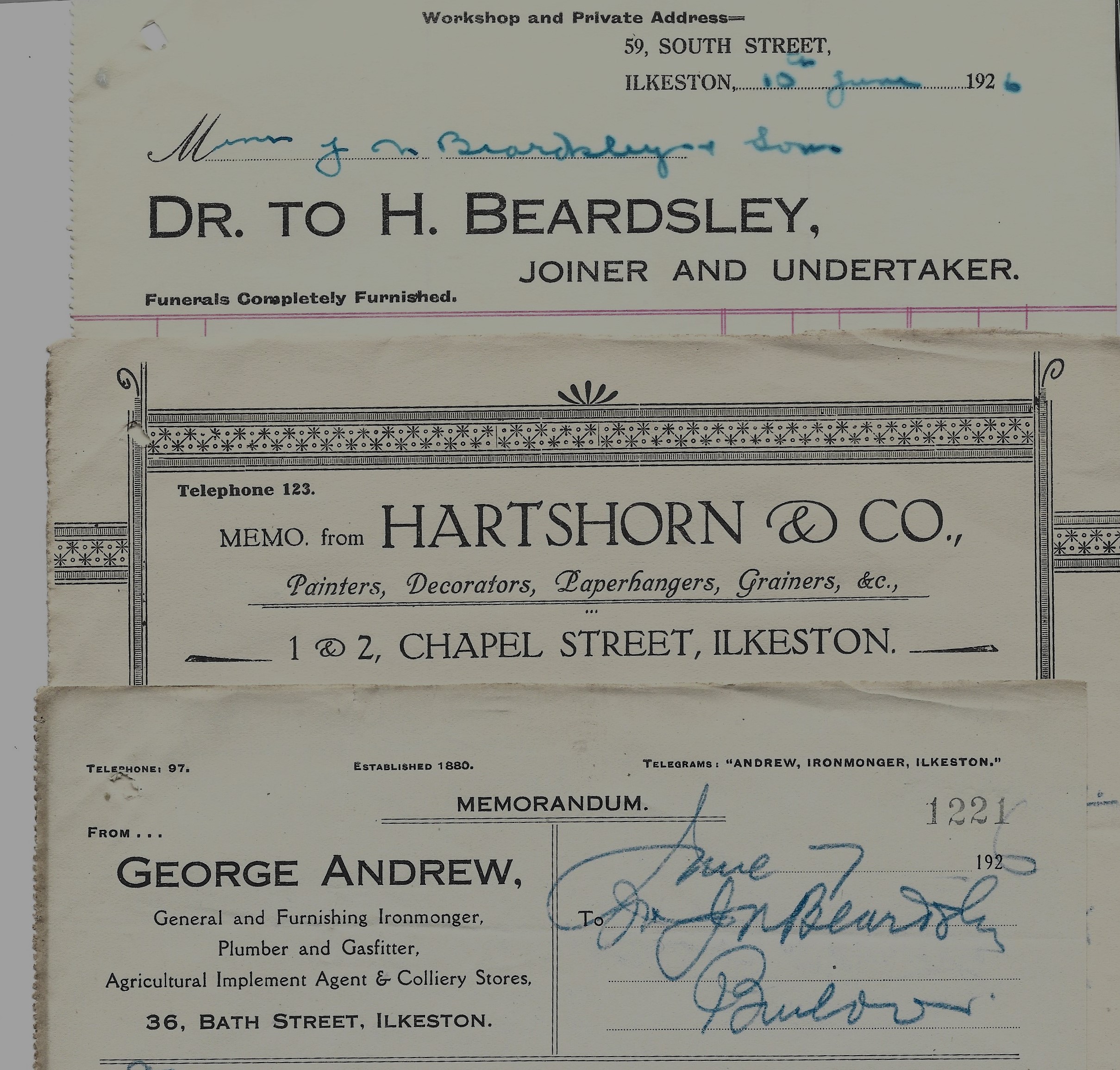
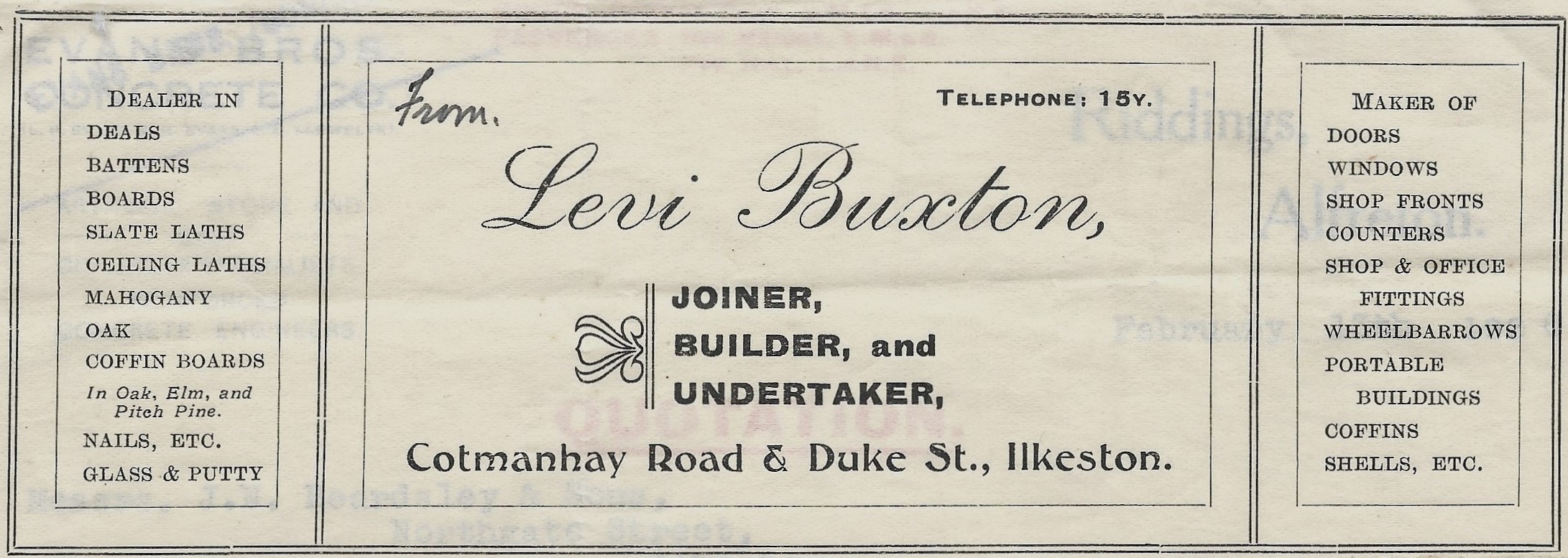
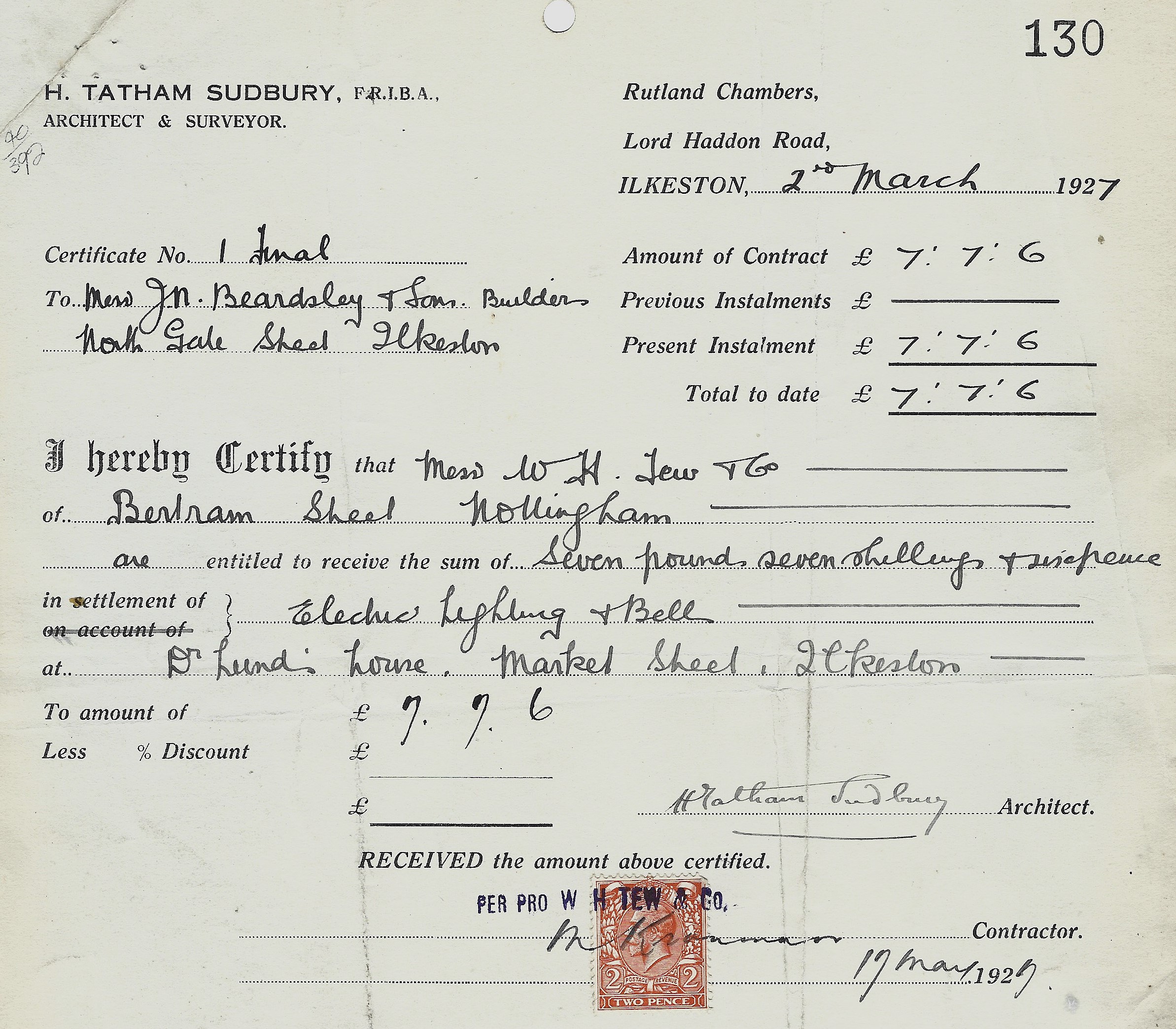
In 1926 Messrs J. N. Beardsley & Sons did extensive additions and alterations on the house, and throughout the contract it was stipulated that all this work was to use the finest materials. Many suppliers were used and I have concentrated upon Ilkeston firms which were employed.
______________________________________________________________________
Northgate Street (1902/03)
Among documents for alterations to a “dwelling house -Northgate, Ilkeston” dated July 1902 and others dated January 1903 is this plan of proposed work to the premises
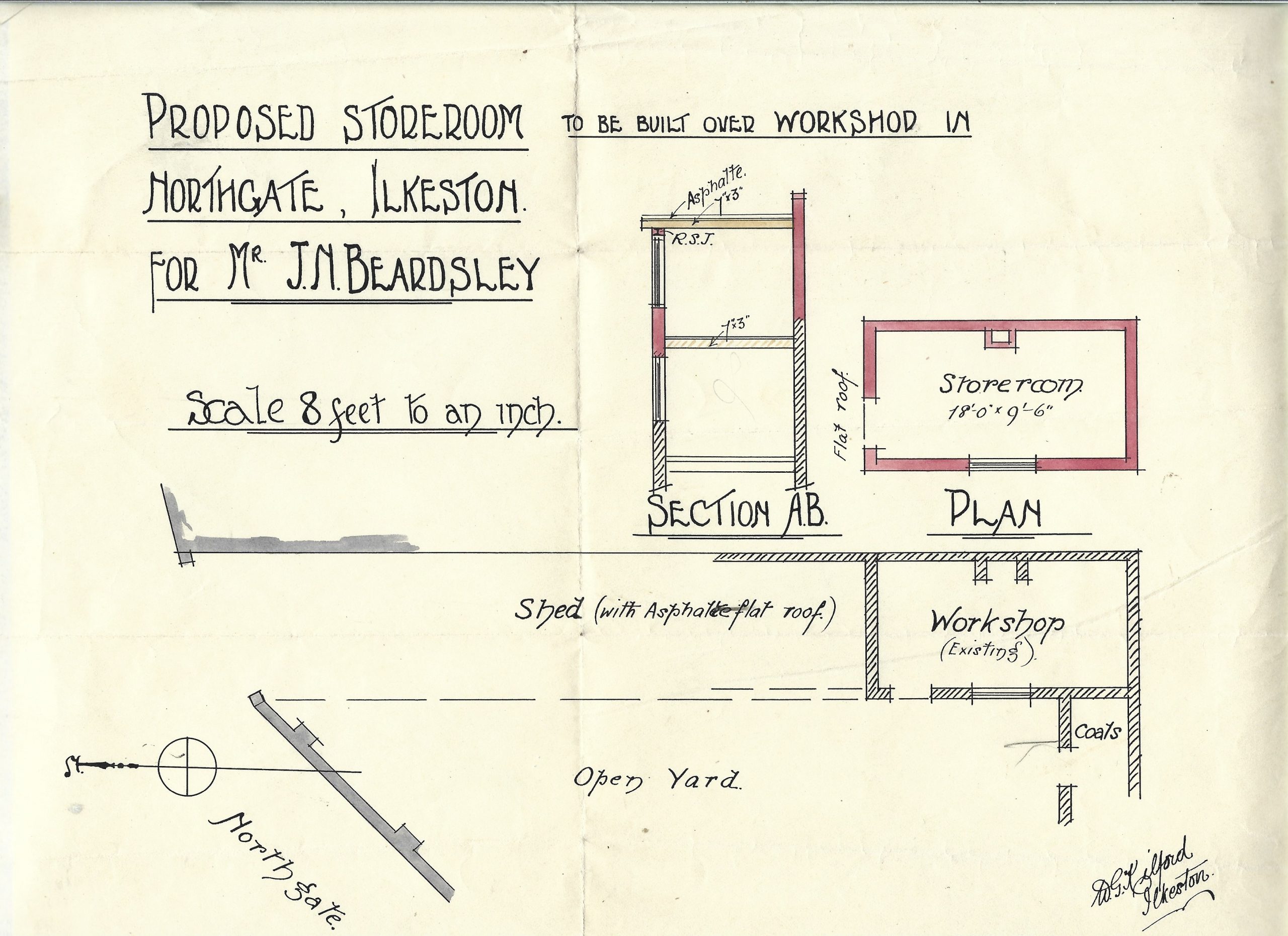
The signature, bottom right, is that of William George Kilford, son of Henry James Kilford, the Ilkeston Borough Engineer and Surveyor from 1887 to 1924.
William George was born in 1887 and would be about 16 in 1903 ?
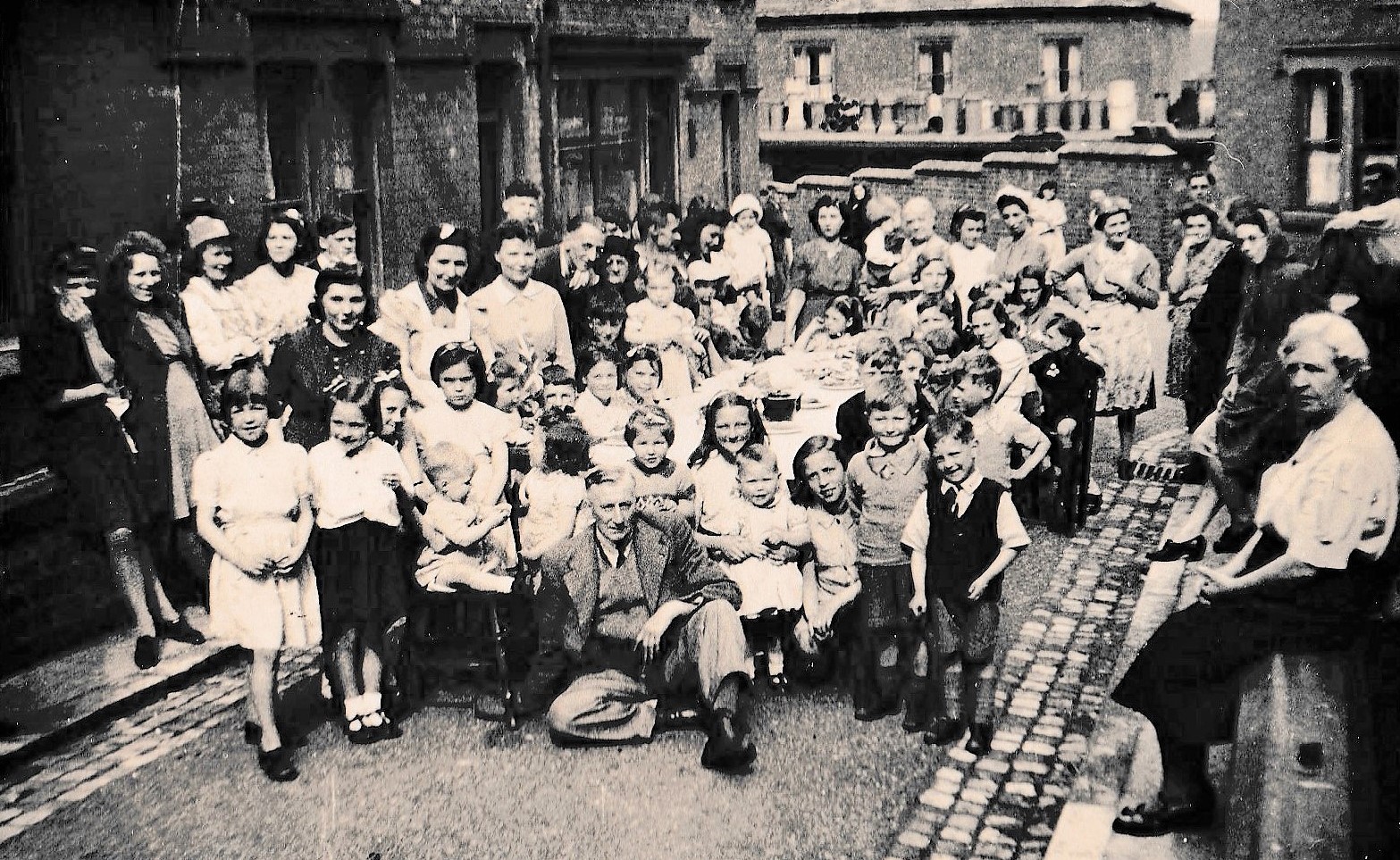
The shed and workshop shown in the plan can be seen in the background of the photo — with the chimney pots stacked on the roof. The photo shows a celebration street party in Northgate Street at the end of the 1939-45 War.
Rutland Terrace (1915)
Rutland Terrace lies to the east of and runs parallel to Lower Granby Street. It was previously known as North Road, not to be confused with North Street. Before the ‘Chalons Way’ era North Street ran from its junction with Burr Lane and Chapel Street, northwards and across Station Road to end just past Lincoln Street and the rail lines to the old Town Station. There was then a footbridge over these lines and Rutland Terrace/ North Road led northwards from the other side of the bridge.
In 1915 John Henry Clay, landlord at the Mundy Arms, 184 Bath Street, and grandson of Henry Clay owned five houses in Rutland Terrace, on the east side and at the south end. In that year he obviously felt his property was in need of new outbuildings — a new coal house and W,C, for each house, and a new communal store for their ashes.
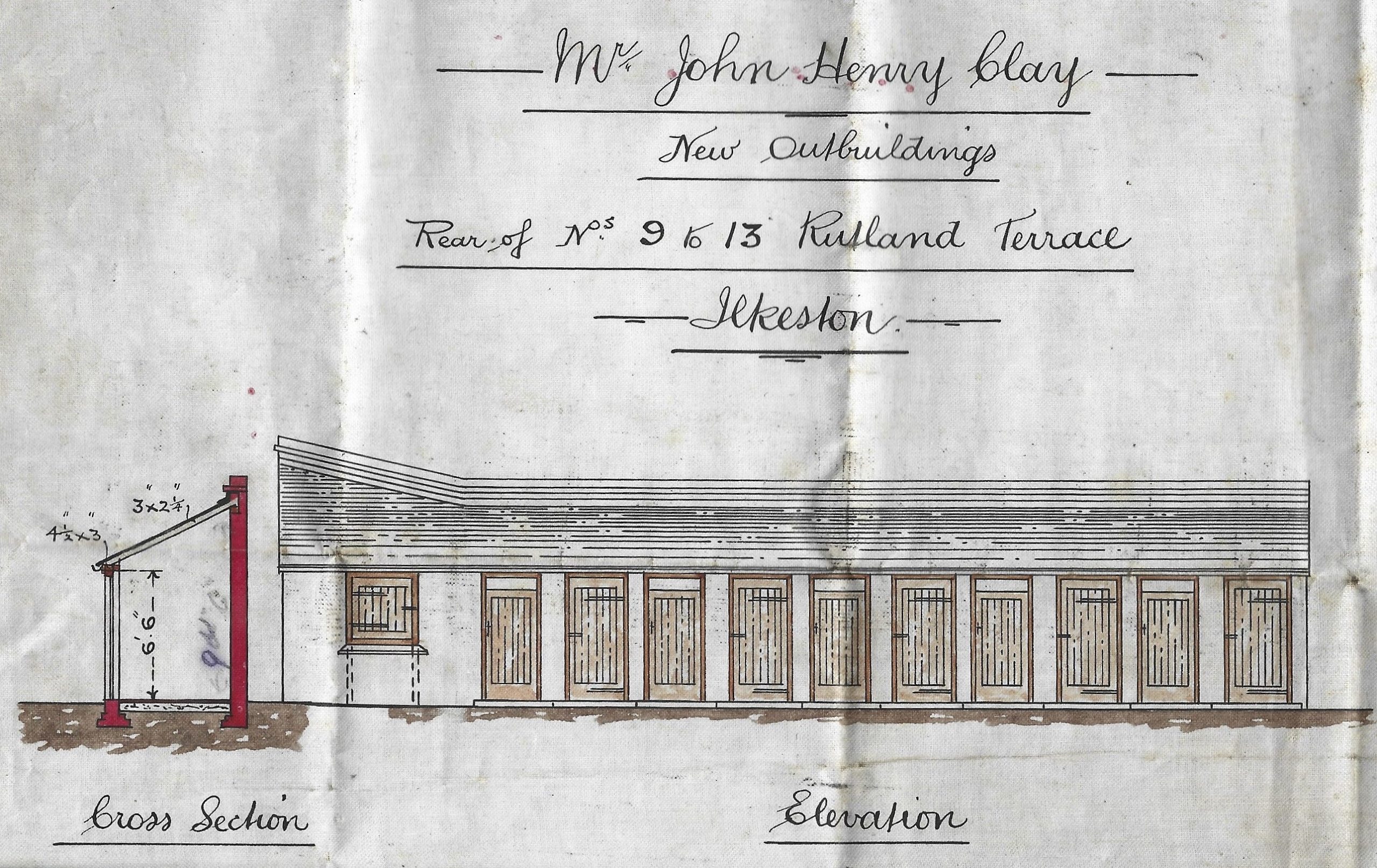
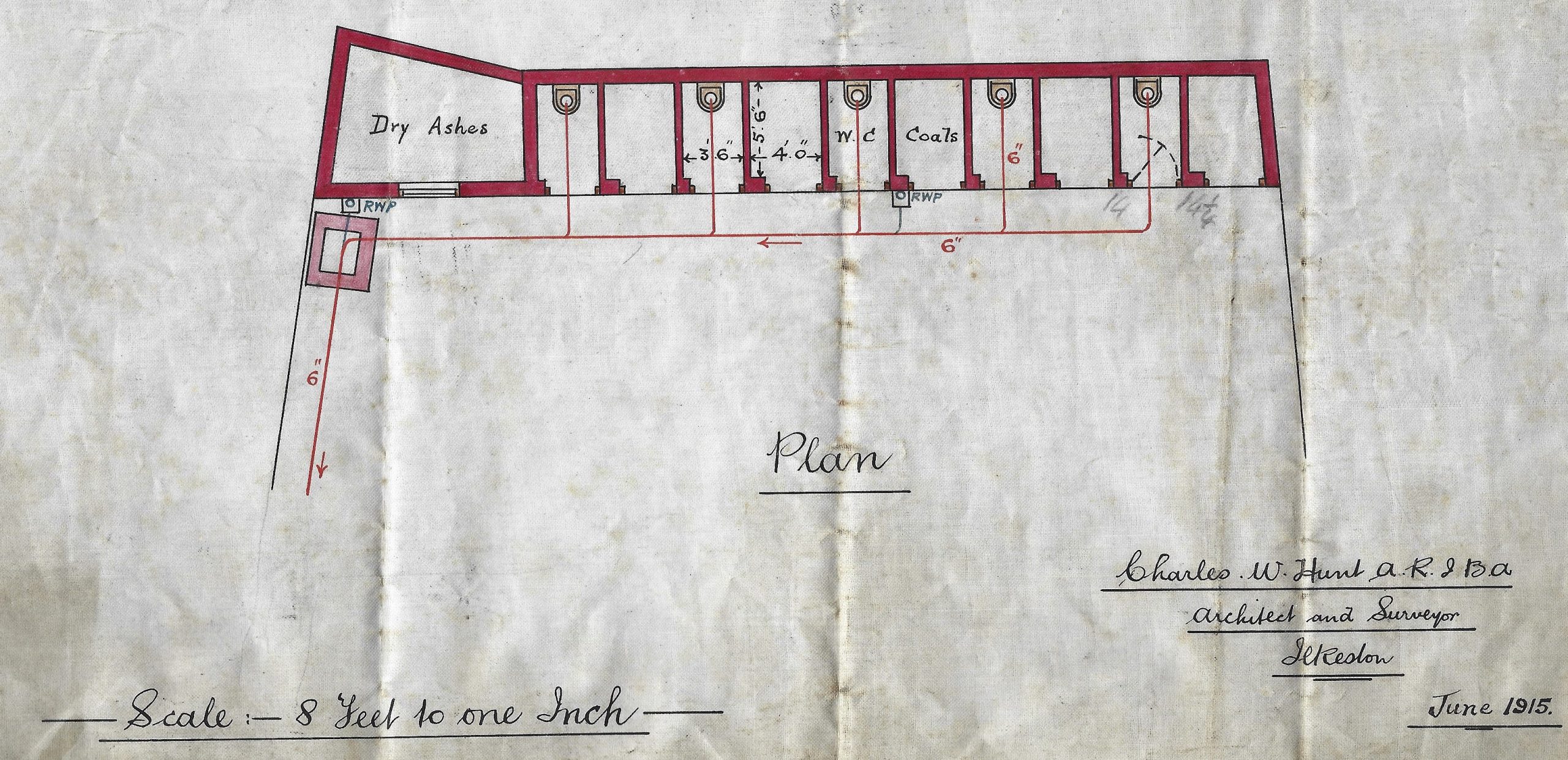
The architect was Charles William Hunt, one of whose other work is featured elsewhere.
Tatham’s Lane/Cotmanhay Road (1917)
Born in 1855, George Beardsley was in later life the head of of the firm “Messrs. G. Beardsley and Co.” glove fabric manufacturers of Manners Buildings in Tatham’s Lane and Cotmanhay Road. He and his family lived at “Wharfdale” in Heanor Road,where he died on April 26th, 1934 (one month after his wife Charlotte).
In 1910 George’s firm had been prosecuted for a breach of the Workshop and Factory Act by using a room which was overcrowded. Not a significant offence, only a small fine was imposed. However at the hearing George had promised that a new factory was being built. Was this it ? Did it take seven years to build ?!
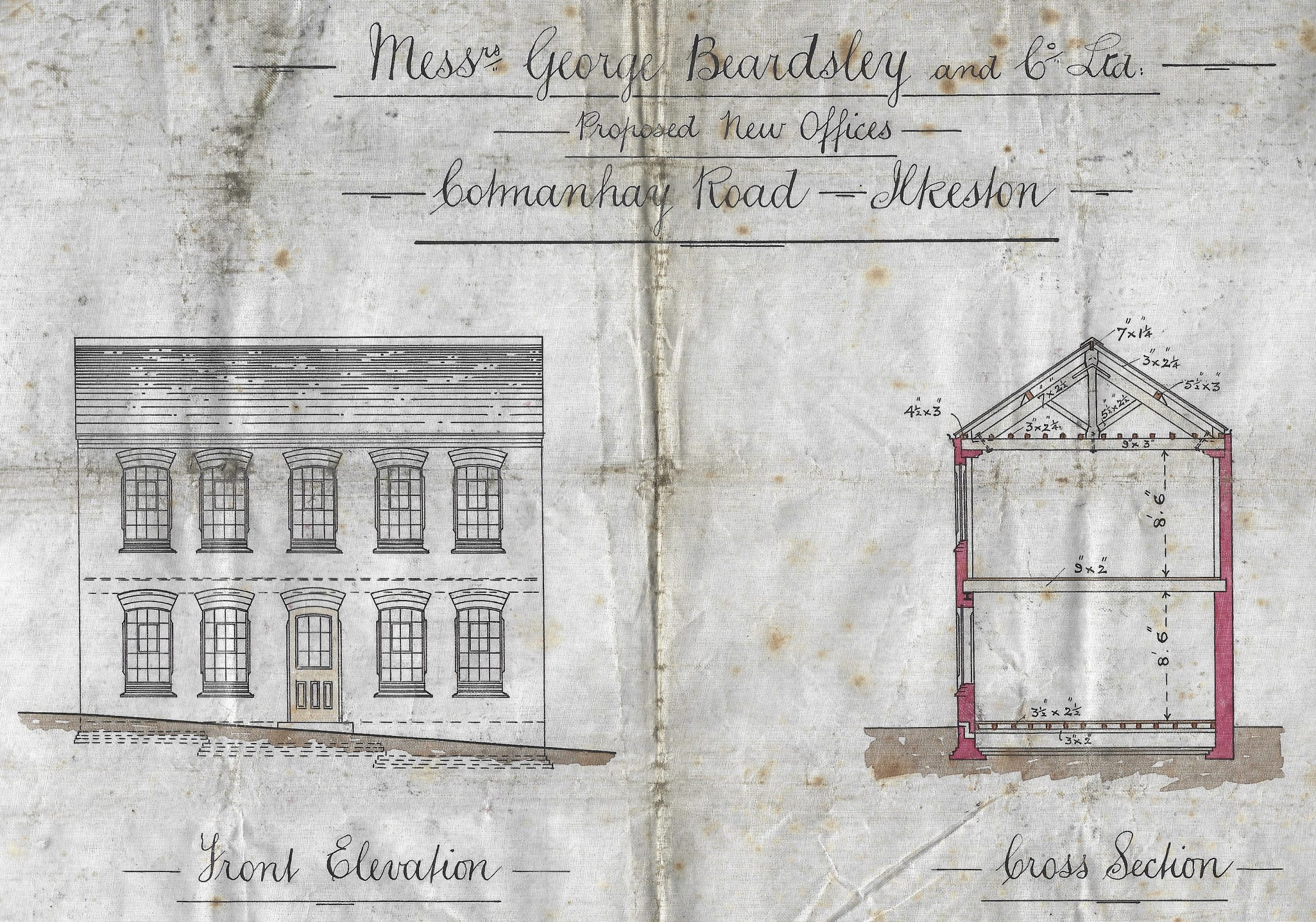
George’s factory buildings have now been demolished to accommodate new housing so perhaps the plans above give an idea of what parts of them looked like when built in 1917. The diagrams show the new additions, with private and general office space on the ground floor and a mending room on the first floor. At the same time a new heating chamber was added, as well as new stores and a blacksmith’s shop.
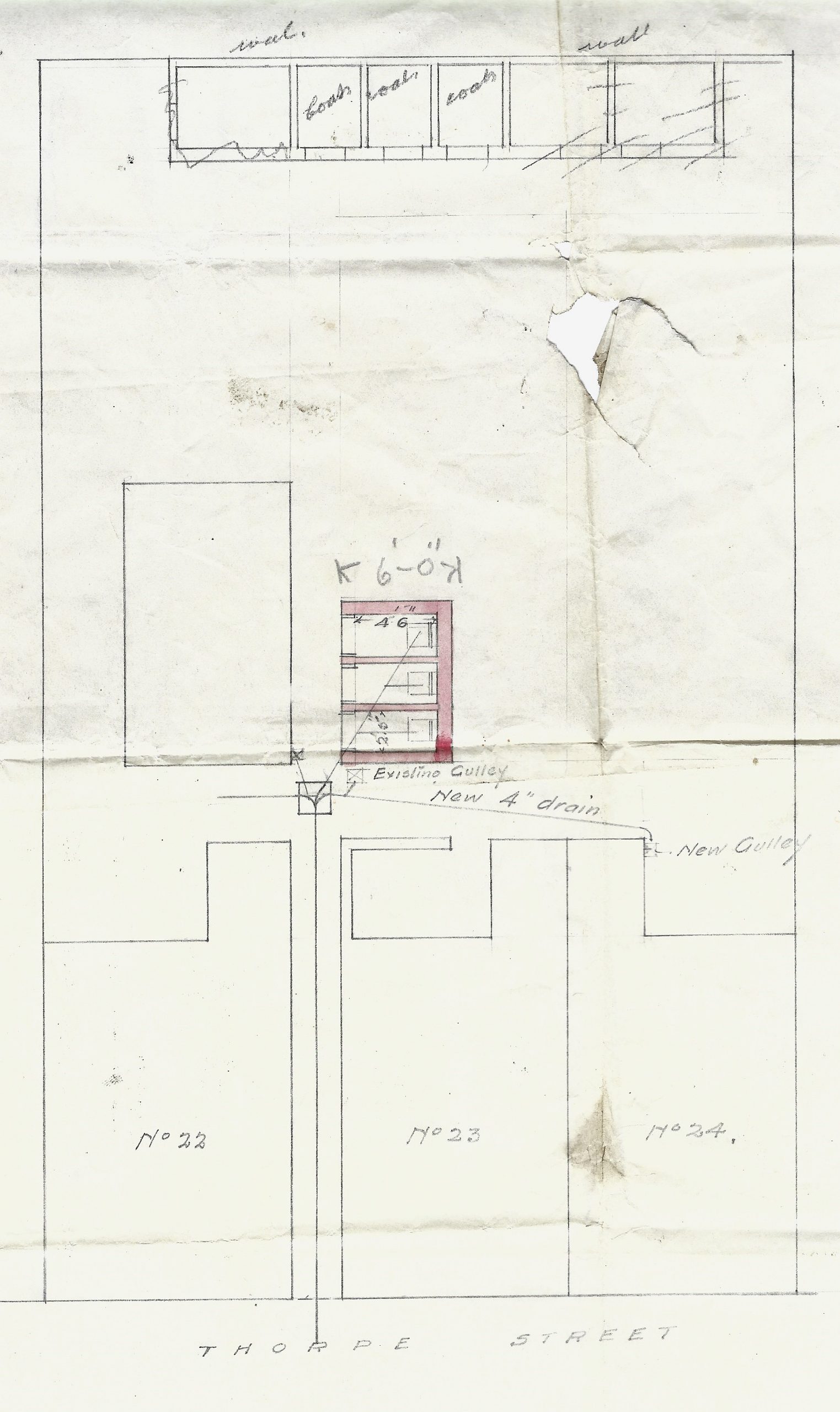
Thorpe Street (1928)
This is a cul de sac off Norman Street.
Norman Street is at its west end (right) and the dead-end at the east.
Numbers 22 to 24 form an isolated block on the south side of the street.
Opposite was another block, numbers 1 to 10, a few of which remain today.
The original outbuildings can be seen at the end of the plot.
J.N. Beardsley & Sons were employed to build three new W.Cs (outined in red). Because of improvements in drainage and sewerage they could be built more conveniently closer to the houses.
Some of these Thorpe Street houses are shown in a photo (here)
Wharncliffe Road (1927)
As you walk down the south side of Wharncliffe Road, away from the Market Place, you come to the impressive United Reform Church (with its Manse next door) which started life as the Congregational Church in 1905. Walk on to encounter the very large Red House, like the Church, designed by architect Harry Tatham Sudbury in the early years of the 20th century.
The next house in your walk was built about 20 years later. This is Croft House, number 48, built by Messrs J.N. Beardsley & Sons in 1927 for Alfred Booth & Sons of Ilkeston, and once more, designed by Harry Tatham Sudbury. The total accepted tender for the work was £1157 19s 3d.
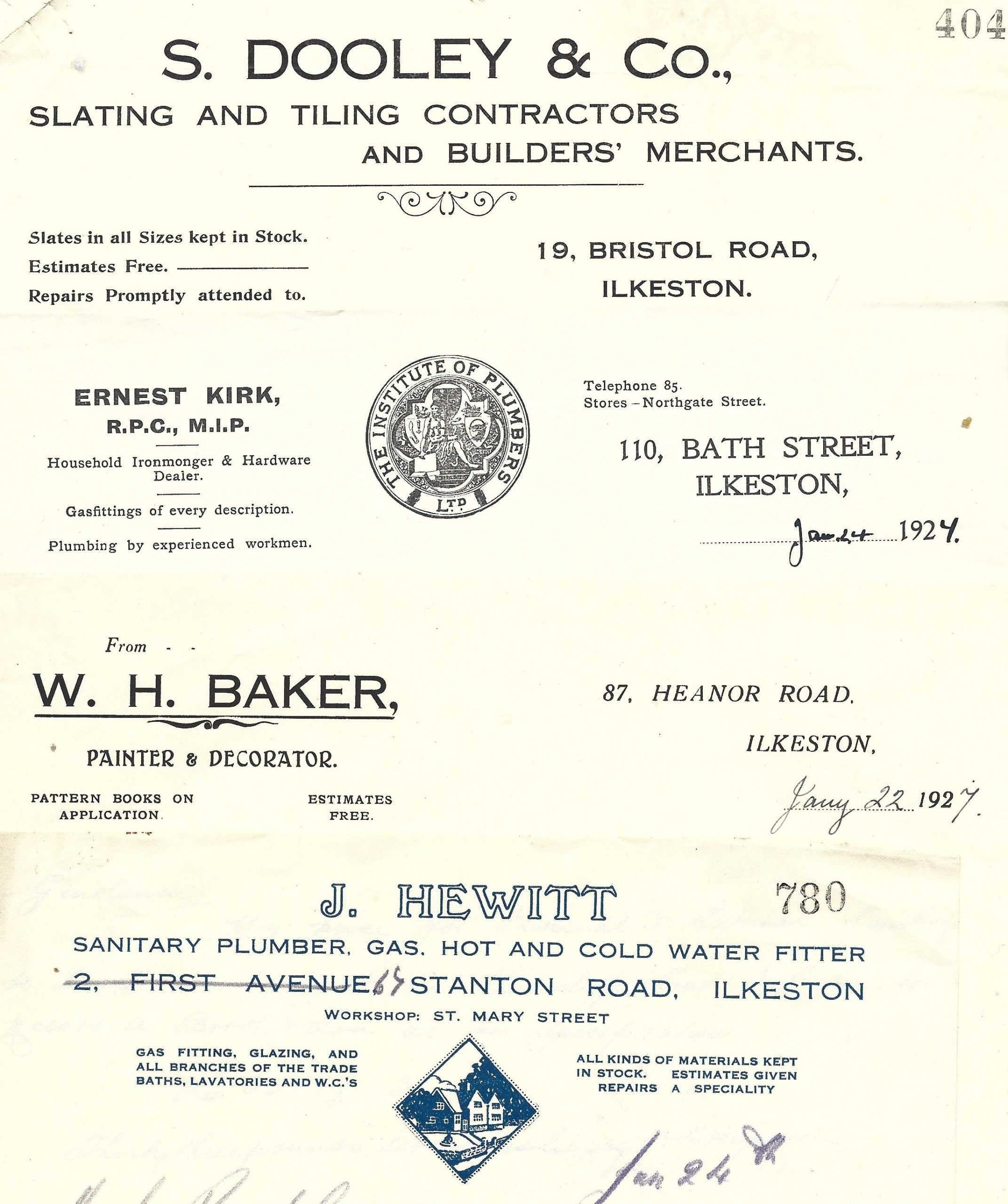
Levi Buxton, George Andrew & Sons. and Hartshorn & Co were all Ilkeston firms once more contacted for estimates. Other prospective suppliers are shown below.
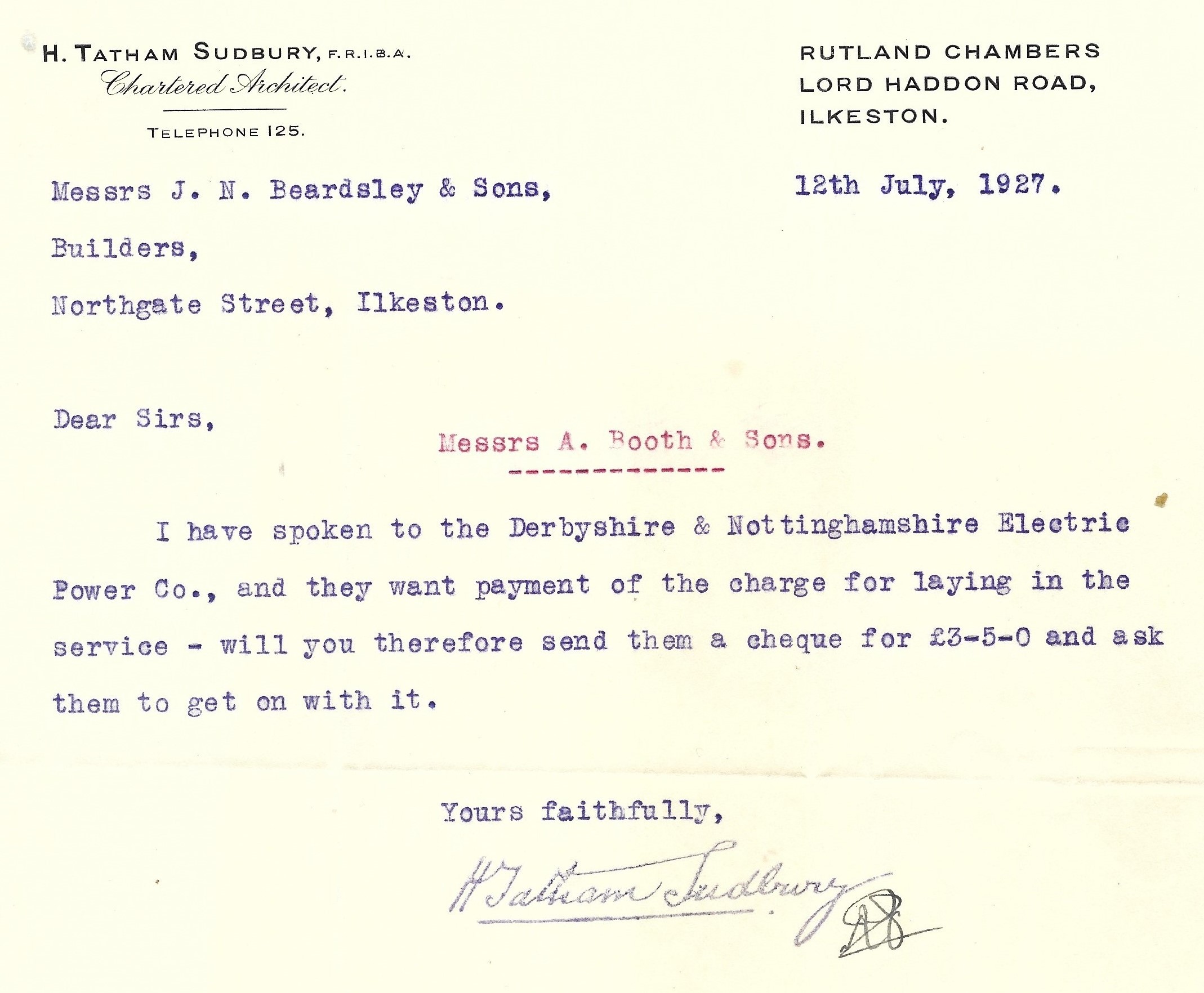
And here is the obligatory “gee-up” note from architect Harry Tatham Sudbury
As with Dr. Lund’s house in Market Street, very precise and detailed specifications were set out, and all materials used and work done was of the highest quality … and closely inspected by the architect. When complete Croft House was used as the family home for Alfred and his wife Charlotte Mildred (nee Hufton). In 1946 they moveed to Wollaton, Nottingham, and Alfred died on June 14th, 1961 at Nottingham General Hospital; his home was then the Rainbow, 608 Derby Road, Nottingham. Charlotte Mildred later remarried in 1963 to Alfred J Walker.
______________________________________________________________________
Other notable buiding projects were completed by the Beardsley family but sadly no documents exist to illustrate many of them.
Some of these have already been recorded on Old Ilkeston Streets 1, while others include a chapel at Stanley Common (1903), ten houses in Bloomsgrove Road (1903), the Cemetery Lodge at Park Avenue (1903), part of the Co-op Building in South Street (1910), Beardsley’s Factory in Mundy Street (1910), Larklands Mission in Park Road (1914) and St. John’s Vicarage in St. John’s Road (1915). These were all complete while James Noble Beardsley (1861-1920) headed the firm.
After the death of James Noble Beardsley, his son James headed the firm. Thereafter, other projects included those shown above, as well as houses in Church Street (1922), a house in Ebenezer Street (1922), the house at 139 Longfield Lane (1936) and one at 141 Longfield Lane (1937).
A final P.S. The firm could be reached by telephone on number 71, then later on 4771, and then on 324771.
______________________________________________________________________
