
Daykin’s Row
Adeline leads us on, just past the Primitive Methodist Chapel and points out that “lower down the street were two or three cottages, built back from the road, on top of the original bank”. Adeline is possibly referring to Daykin’s (or Dakin’s) Row, deriving its name from occupant John Daykin, a lace agent.
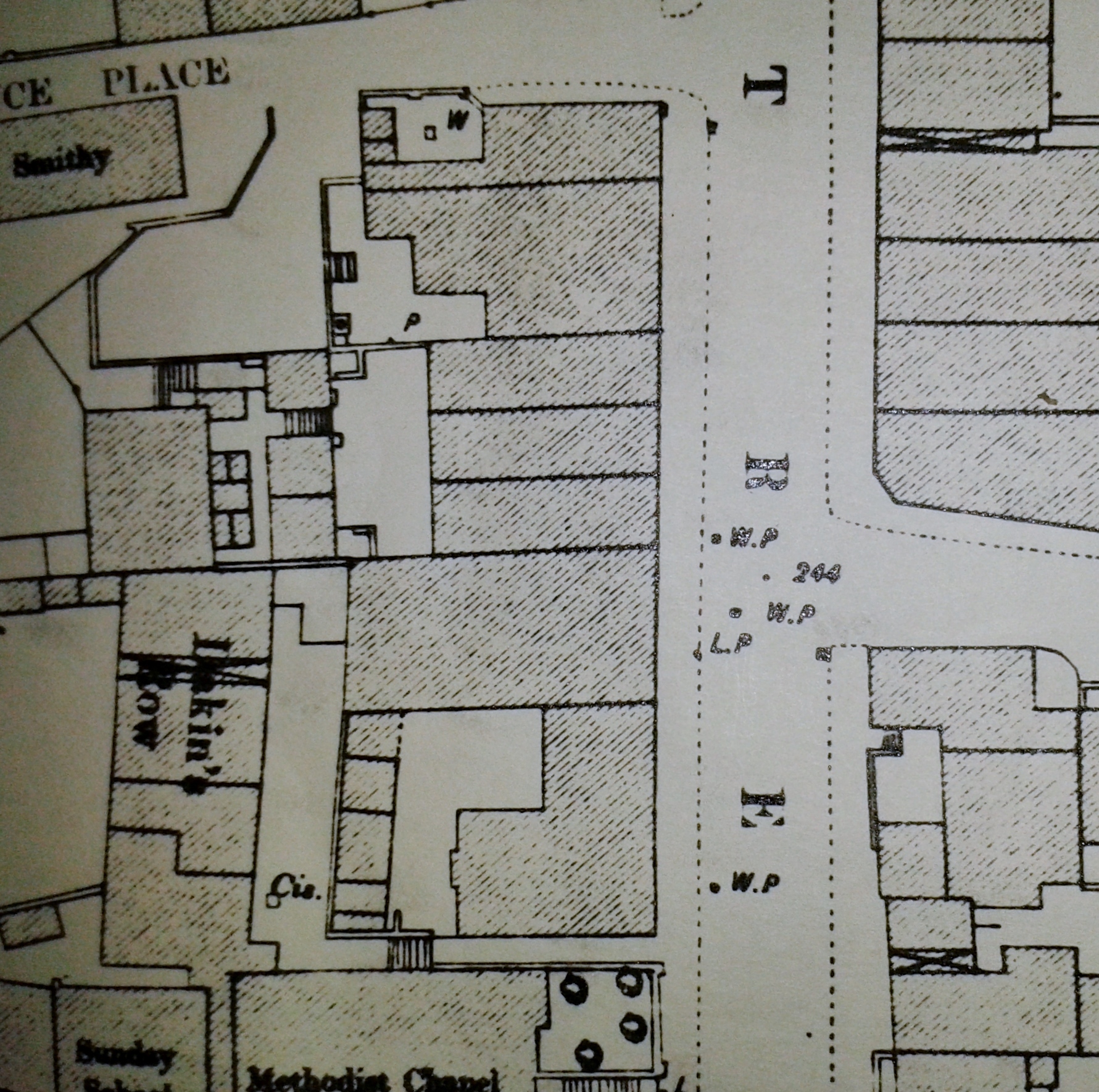
from the 1881 O.S Map of Ilkeston
Born on July 14th, 1804 John was the son of framework knitter Joseph Daykin and Ann (nee Briggs), and a cousin of Richard Daykin who lived in South Street.
John’s father Joseph was a Chelsea Pensioner and his death is recorded in several local sources. For example — “On the 4th of October, 1856, there died at Ilkeston, an old veteran, named Joseph Daykin, who was formerly a sergeant in the Coldstream Guards, and was wounded by a musket shot in the head, at the landing at Camperdown, in Holland, in 1799, under General Abercrombie. At the time of his death he was 79 years old, and had enjoyed his pension 54 years” . (Edwin Trueman .. History of Ilkeston 1880)
In the summer of 1854 there was a spate of ‘garden robberies’ at various places in town and one victim was John Daykin, the lace agent of Bath Street. In June he lost from his garden a score of his best cabbages, a whole bed of shallots and a crop of onions; John was determined to catch the culprits or at least give it a try.
Consequently on the Friday night following his loss, he positioned himself, carefully hidden and as comfortable as he could, in a cart in the garden. And then waited !!
The vigil did not last the whole night however — it started to rain so heavily that John decided to retire indoors and into his bedroom, overlooking the garden. Just about to get into bed, a noise from the garden alerted him to the possibility that the robbers had returned for more loot. Armed with hedge-cutters the intrepid lace-man descended to the garden and confronted three thieves, all well-known to John. One of them resisted the attempts to apprehend them and, in the scuffle which followed, lost part of a finger — chopped off by the cutters. The wounded fellow was taken indoors by John who bound the injury and then succumbed to the repentance tears, prayers and promises of the prisoners — he consented to free all of them and ‘give them another chance to amend their manner of living‘ … or to attack someone else’s garden !?!
John Daykin died in Daykin’s Row on June 23rd, 1875, aged 70.
——————————————————————————————————————————–
The Daykin family bible
The following section is based upon family documents belonging to Simon Dodds and his family. Simon has very kindly sent a selection taken from the family bible. The entries begin outside of Ilkeston in the late 18th century with the Turner family. It was originally written by someone close to the family, with intimate knowledge of the births and deaths up to the 1850s …. most probably Sarah Daykin (1828-1892) who was given the bible by her grandmother Martha Turner (nee Fox)
I have transcribed the pages as best I can and have added detail from other sources, mainly parish records. I have followed the events as they are set out on the pages and obviously there may well be mistakes in transcription.
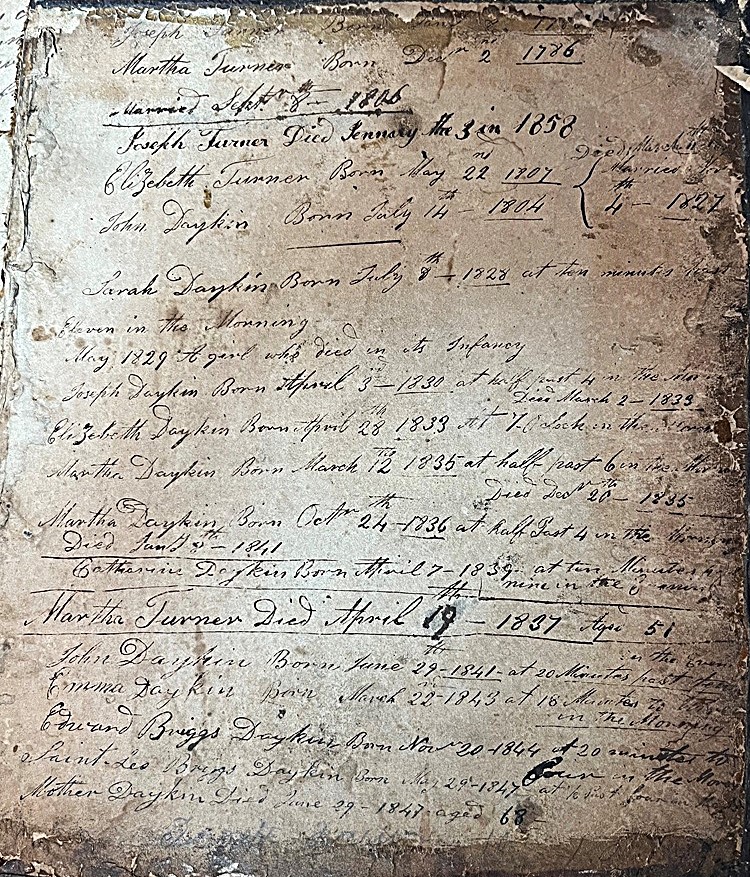
We start with Joseph Turner who was born about May 24th, 1785, at Repton in Derbyshire, the son of William and Mary Turner.
He married Martha Fox on September 8th, 1806 at St Peter’s Church in East Bridgford. The bride had been born at that village on December 2nd, 1786 and baptised at that church the following day; she was the daughter of Joshua and Elizabeth (nee Clark?)
Joseph Turner died on January 3rd, 1858 at Ilkeston, aged 74.
The daughter of Joseph and Martha was Elizabeth Turner, born at Repton on May 22nd, 1807 and baptised there on July 30th, 1807.
Elizabeth married John Daykin on November 4th, 1827 at St Mary’s Church in Ilkeston. John had been born at Ilkeston on July 14th, 1804 and baptised at St. Mary’s on August 5th 1804, the son of Joseph and Ann (nee Briggs).
Elizabeth Daykin (nee Turner) died on March 11th, 1850, at Ilkeston, aged 43, and was buried at St. Mary’s on March 13th.
The first child of John and Elizabeth was Sarah Daykin, born at 11.10 am on July 8th, 1828. She was baptised on August 3rd, 1828 at St. Mary’s.
Their next child was an unnamed daughter, born in May 1829, who died in infancy.
Son Joseph Daykin was born at 4.30am on April 3rd, 1830. He died on March 2nd, 1833 and was buried at St. Mary’s on March 4th..
Daughter Elizabeth was born at 7am on April 28th, 1833 at Sandiacre and baptised at Ilkeston Wesleyan Methodist Chapel on May 23rd.
Martha Daykin was born at half past six in the morning (?) on March 12th, 1835; she died on December 20th, 1835 and was buried three days later, at St. Mary’s Church.
Martha Daykin the second was born at 4.30am on October 24th, 1836 and died on January 8th, 1841; she was buried two days later.
Final daughter Catherine was born at 10 minutes to nine on April7th, 1839.
Martha Turner (nee Fox), mother of Elizabeth Daykin (nee Turner), died on April 19th, 1837, aged 51, at Ilkeston and was buried two days later at St. Mary’s Church.
Continuing the children of John and Elizabeth Daykin …
Son John was born at 10.20 pm on June 29th, 1841. (Just about 3 weeks too late for the 1841 census)
Emma Daykin was born at eight minutes to 11 (?) on March 22, 1843.
Edward Briggs Daykin was born at 20 minutes to four in the morning on November 20th, 1844.
Saint Leo Daykin was born on May 29th, 1847, at ? past four in morning.
(Not mentioned in the family bible is the birth of an unnamed son in the first quarter of 1850, and who died in infancy. Did his mother die in childbirth ?)
The final event mentioned on this page is the death of “Mother Daykin” … that is Ann Daykin (nee Briggs), mother of John senior, on June 29th, 1847, aged 68.
(Something appears to be written at the foot of the page which I can’t read).
The details in the two pages (below) are essentially the same, the first one written by the same person as the page above ? The second one is a copy of the first ?
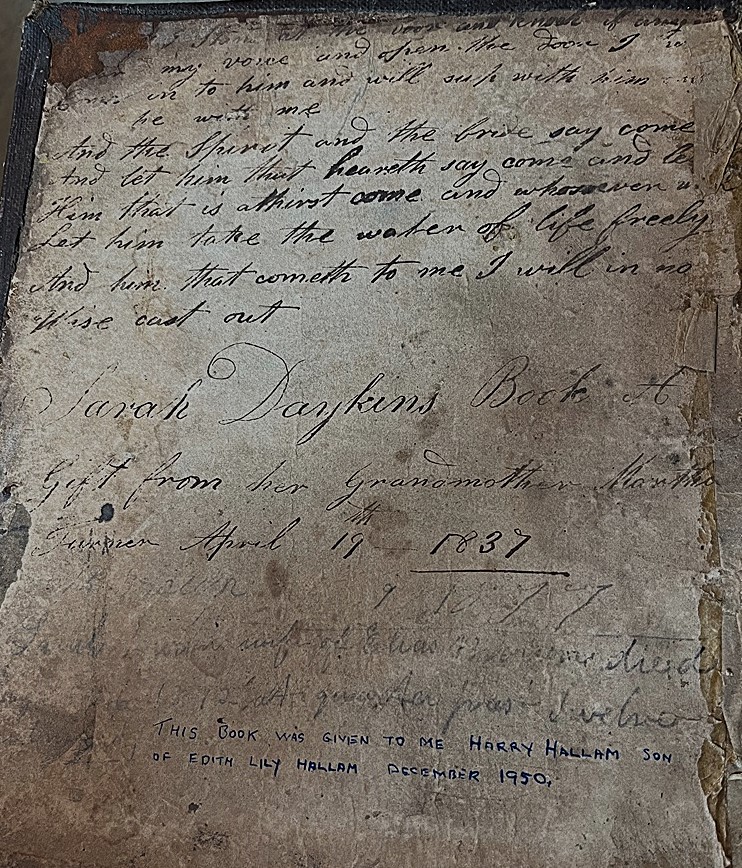
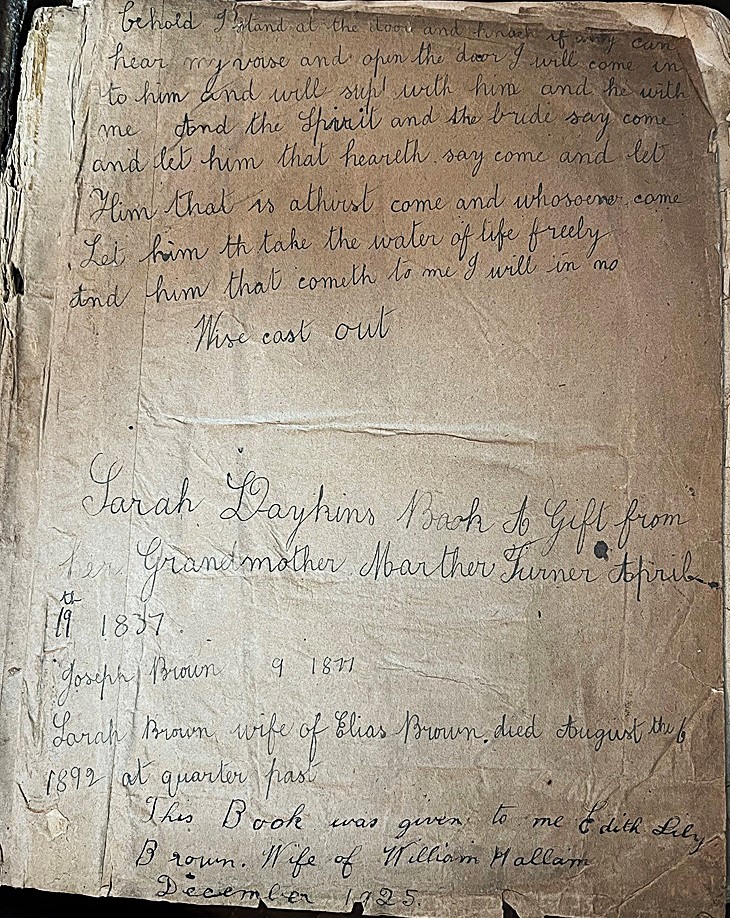
Transcription:–
Behold I stand at the door and knock. If any can hear my voise and open the door I will come in to him and will sup with him and he with me. And the Spirit and the bride say come and let him that heareth say come and let Him that is athirst come and whosoever come Let him th take the water of life freely And him that cometh to me I will in no Wise cast out
Sarah Daykins Book a gift from Grandmother Martha Turner April 19th 1837
Joseph Brown 9 1877
Sarah Brown wife of Elias Brown died August 6th 1892 at quarter past … (she died on August 25th; this was Sarah Daykin who married Elias Brown on October 2nd 1849 at St. Mary’s Church. He was the son of John Rawdin Brown and Sarah (nee Beardsley)
A few additional notes: The text at the beginning of this page in the bible is taken from the Revelation of St John the Divine.
I am unsure of the entry “Joseph Brown 9 1877”
You will notice that the bible was passed on to Edith Lily Brown, daughter of John Rawden Brown and Kate Elizabeth (nee Bushwell) in 1925. John was the son of Elias and Sarah Brown.
Edith Lily married William Hallam in 1915 and then lived at 7 Alvenor Street. Their son was Harry Hallam and the bible was passed on to him in 1950.
——————————————————————————————————————————–
Towards the New Inn and Providence Place
Adeline then continues her journey past Daykin’s Row and down Bath Street. She identifies “a waste piece of land in front of these cottages, and on the street level was where wheelbarrows, etc., were parked”.
Around here was the shop of chemist William Fletcher – at what was to be 34 and 35 Bath Street by 1881. When Bath Street was renumbered in the late 1880s, this side housed the odd numbers and William’s shop became number 69. He also had a branch in Granby Street.
A couple of years after marrying Emma Jane Taylor, on September 17th 1867, William and his family arrived in Ilkeston where he set up shop in Bath Street, and was to become a well-respected tradesman and community member of the town.
Many young men, apprenticed to William, would thank him for a valuable experience. One such apprentice was Samuel Daybell, eldest son of Ilkeston’s Superintendent of Police. In 1896 Samuel passed the exam of the Pharmaceutical Society of Great Britain ‘with the highest honours at the first attempt’…. thus becoming a fully qualified chemist and druggist. Young Samuel had worked with William for several years and it was this background which contributed significantly to his exam success .. as wel as his work with William’s son, William George, also a chemist and druggist.
Another apprentice was Robert James Platt who, after an apprenticeship, had later success with his own Ilkeston business.
And next door to chemist William – at 39 Bath Street in 1871 — was the New Inn. And then Adeline point out “a road leading to the fields”. This would be in the area of what was later Providence Place,
———————————————————————————————————————————
Before we continue our journey down Bath Street, let’s take a quick detour across the road and into Chapel Street to look at the Salvation Army in Victorian Ilkeston.
